Photographers
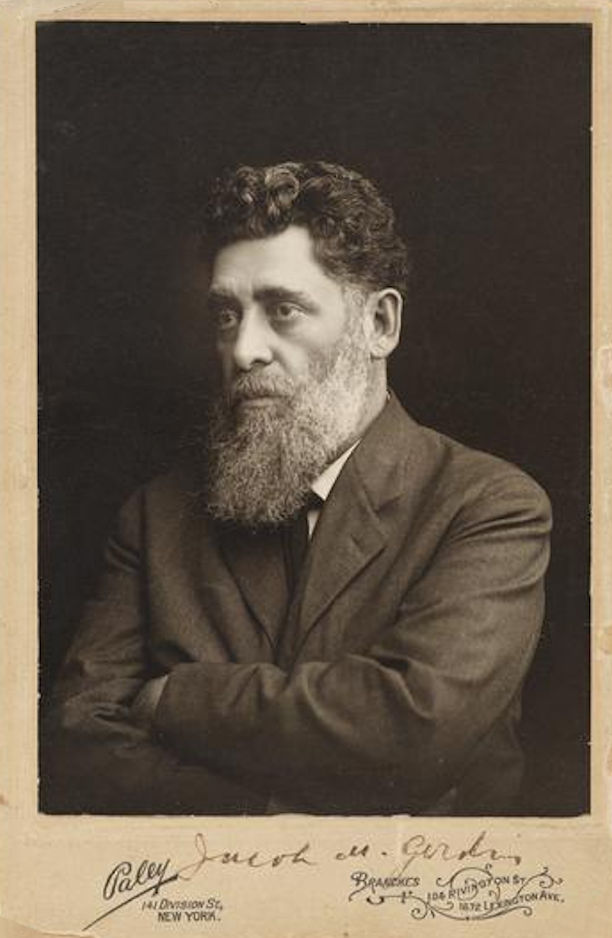
Paley Studio
141 Division Street
New York, New York
Sitter
Jacob Gordin, May 1, 1853 - June 11, 1909
Date
circa 1900
Type
Portrait
Medium
Cabinet
Photograph
Credit Line
Museum of the City of New York
Accession Number
X2012.7.322
Testimony
"At that time, when the leaders of the Yiddish theatre
looked down on the writer, James Gordin arrived in New York.
This was in 1890. When they told Jacob Gordin about the
condition of the Yiddish theatre, about the relation of the
actor to the writer, that they think a writer is a "yold,"
this did not frighten Gordin. "They can be taught," he said,
"They need to teach the actors, and they need to teach the
people to understand theatre."
Jacob Gordin came to America with a rich
literary baggage. There was in the old country, in
Yelisavetgrad, the founder of a biblical organization that
recognized only the bible, and not the Talmud. In the old
country he was a private teacher and also used to write
feuilletons in the Odessa newspaper, "Odesskii Listok." He
also wrote for the Odessa weekly page, "Nerelia." He used to
sign [his name as] Ivan Koliutsky (Ivan the Prickly?). He
was said to be a radical and used to openly come out with
lectures. The Russian government kept an eye on him, and
because of this he left Russia.
When he came to America, no one expected that
he would choose the Yiddish stage for his career. He spoke a
hard Yiddish, although as a katzap [nickname of a
Russian], he wanted to speak Yiddish. Here they gave him a
position as an editor of a Russian weekly newspaper, which
did not last long. He then wrote in the weekly "Arbayter
Tsaytung," which paid very little to its writers.
Philip Krantz then gave him a plan with which
he could write a play for the Yiddish stage, and he wrote
his first play, with the name, "Siber (Siberia)." The
play was staged by Jacob P. Adler.
With the play, "Siberia," he began a new
chapter in the history of the Yiddish stage. From the
deytshmerish epoch with swords, kings, princes and overdone
costumes, which was then borne in the plays of Professor
Horowitz and Joseph Lateiner, and the play, "Siberia," there
was a revival for the Jewish-Russian intelligentsia in
America."
Source of Testimony
Joseph Rumshinsky -- "Joseph Rumshinsky Tells About Fifty
Years of Yiddish Theatre," Forward, March 30, April 6, 1918.