Photographers
unknown
Sitter
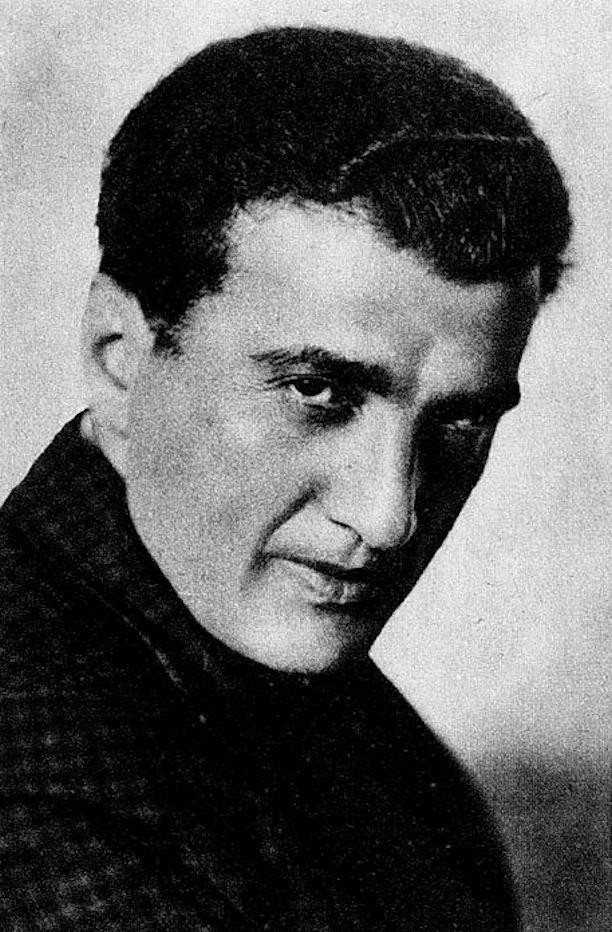
Samuel Goldenberg, February 8, 1886 - October 31, 1945
Date
unknown
Type
Portrait
Medium
Photograph
Credit Line
The Jewish Forward
Testimony
"In those days the Yiddish theatre
world began to look to the heavens for a new star for the Yiddish
theatre. And as did once the great Italian maestro Toscanini answer
a prima donna for the Metropolitan Opera House, when they were both
confused. "I am a star," she wrote, and he answered: "Stars are only
in heaven, and you spin around on the boards of a stage."
But a star is a star, and as clouds
began to arrive on the stars of contemporary Yiddish theatre, the
Yiddish theatre looked for a new star. Without violence, without
shouting, there was announced in a mid-week performance the
appearance of an unknown, foreign actor, in an unknown, foreign
play. But one saw for oneself an elegant, unpretentious figure, with
a tasteful, elegant and elastic, flexible, a European attitude;
one who has who to sell to the public, and mostly how to sell the
art. Overnight there came a new star from the heavens for the Yiddish
theatre, Samuel Goldenberg.
In Yiddish theatre there began a great
debate and argument, which became a new theme -- Goldenberg.
The play in which Goldenberg performed
in for the first time in America was a Spanish drama by Gimari, in
Yiddish it was called, "Oyf der zindiger erd (On the Sinful
Earth)." Many actors felt that Goldenberg was indeed very good in
the play, but they wanted to see him in a Yiddish play from our
repertoire.
The second play in which Goldenberg
appeared was Anshel Schorr's "Shir hashirim (Song of Songs),"
with my music. In "Shir hashirim" Goldenberg had already convinced
the "patriots", the critics, the actors, mainly the constant,
non-forgivers, that he could act in a play from our repertoire,
and that he is one of us, a Yiddish actor with all the virtues, and
one virtue, an addition who was well-received in the play, "Shir
hashirim": like the role from "Shir hashirim" is that of a music
professor who has to play the piano on stage.
When they performed the play for the
first time in New York, with Morris Moshkowitz as the music
professor, I used to play the piano from behind the stage, and
Moshkowitz used to sit at the piano on the stage, like he was really
playing it. But Samuel Goldenberg appeared that beyond the
magnificent acting of the romantic, passionate, elegant, noble music
professor Oppenheim, that only Samuel Goldenberg knew how to play,
that indeed he alone was playing the piano, and it appeared that
besides a great actor, he was a good pianist and very musical.
The first play in which Goldenberg
performed was a Spanish one; the second, "Shir hashirim," he had
seen Morris Moshkowitz play in London (He indeed acted in the London
Pavilion Theatre, where Morris Moshkowitz was a star and
manager), and the patriots (i.e. fans) of Adler and Kessler, with
the entire theatre family, had proposed that they wanted to see
Samuel Goldenberg in a new play, in which he alone would play the
role and play this type.
During that time, patriots or critics
had plenty of sway over who would be performing.
They staged a drama of New York life,
written by Osip Dymow, "Der shtot gayst (The Town Spirit),"
in which Goldenberg played Mephisto, a type of Uriel Acosta, and
although the play did not have the wished-for success, Goldenberg
however showed that they could rely on him.
In two months' time, Goldenberg stood
on the star pedestal as a "full-fledged star" of the Yiddish
theatre."
Source of Testimony
Joseph Rumshinsky, "Joseph Rumshinsky Tells About Fifty
Years of Yiddish Theatre," Forward, March 16, 1953.