|
A History of The Folksbiene
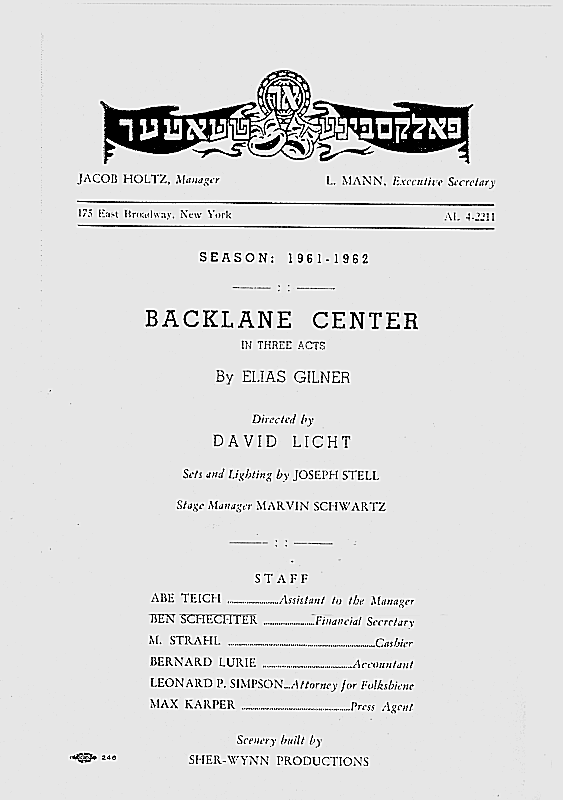
Backlane Center
by Elias Gilner
1961-1962 Season
Folksbiene Playhouse
175 East Broadway
New York, NY
 |
|
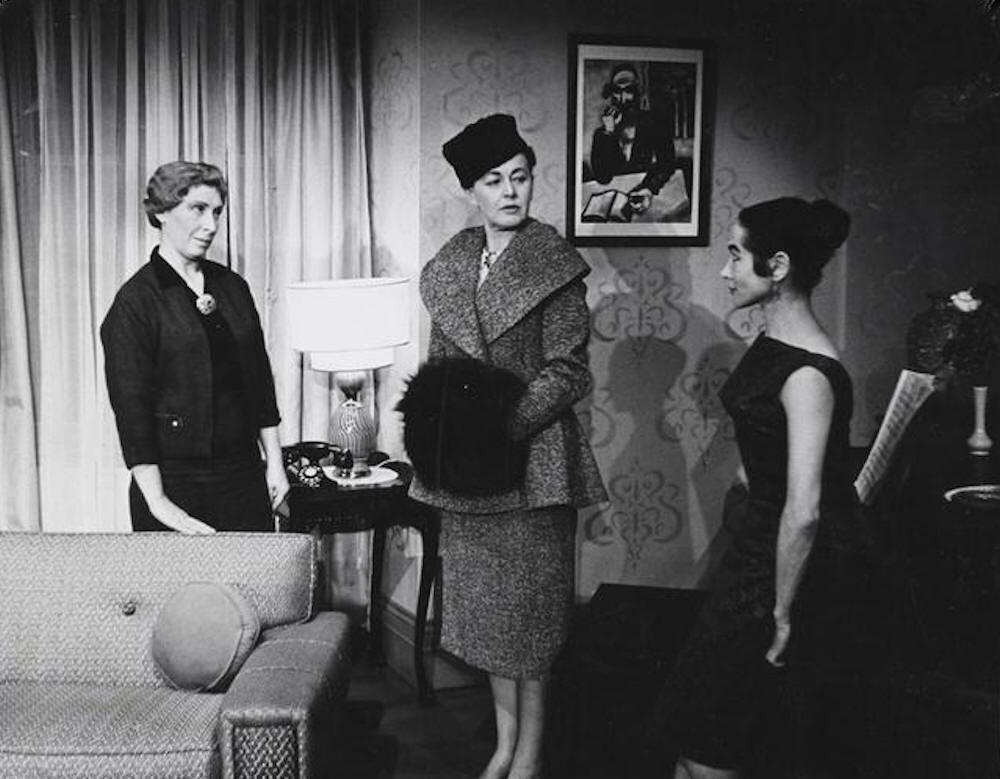
Sasha Gottlieb, Mina Kern and Zypora
Spaisman
|
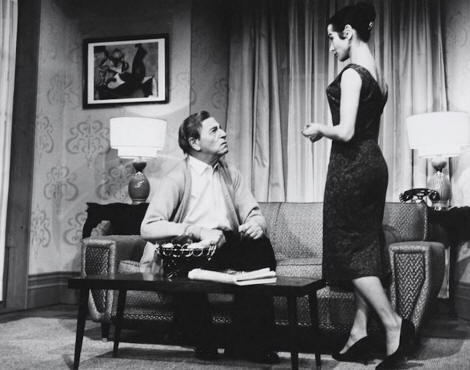
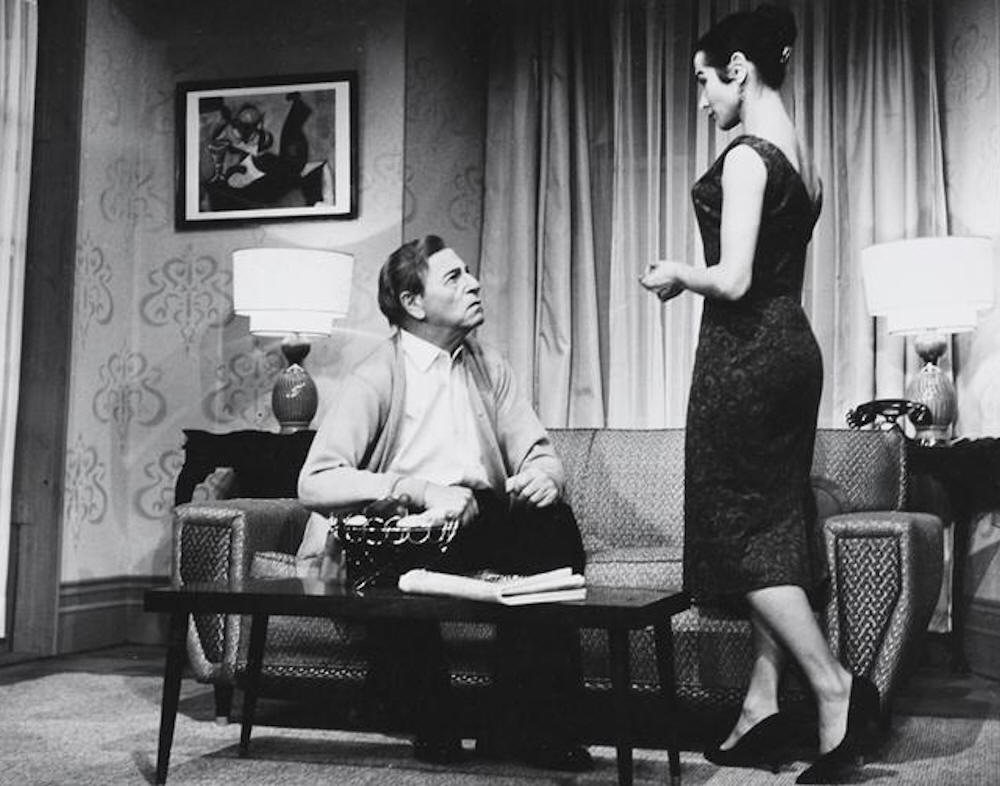
Harry Rubin and Sasha Gottlieb
Both photos courtesy
of the Museum of the City of New York |
| A review from the New York Times,
November 23, 1961
YIDDISH DRAMA ABOUT SUBURBIA OPENS
"Backlane Center," a somber survey
of Jewish stress and strain in Suburbia, opened true to the
traditions of Yiddish melodrama at the Folksbiene Playhouse last
night. It will be given Saturday nights and twice on Sundays.
Elias Gilner was not so much
interested in the foibles of life on the new hedge-lined
frontiers that are yet another step further from the immigrants,
gangplank, although he touched knowingly, but briefly, on some
of the minor pretensions and activities. The playwright stet
himself the goal of unveiling the brutality of conformity and
the effect of the transition on the younger generation.
His tragic hero is the executive
director of the center of the title role. He is embroiled in
three crises. One pits him against the Babbitts and climbers,
who invite as a guest speaker a reactionary congressman who
speaks for forgiveness for the Nazis. A second has him pleading,
unsuccessfully, with his daughter, who is in love with a German
immigrant boy, the son of Nazi parents. A third finds him
learning of the rejection of a manuscript he has written because
"there is no market for truth."
These are not peculiarly suburban
problems, and they even recall some of the earlier Yiddish plays
in which the parents were torn emotionally by the move to uban
America from the rural ghettos of East Europe. However, Mr.
Gilner's play tackles its them earnestly and at times
eloquently.
The drama is enhance by an expert
performance under the direction of David Licht. His cast, with
wonderfully mobile facial expressions, gestures and shrugs,
strengthened somewhat the failings of the script. Harry Rubin as
the center's executive has the deep voice and masterful manner
that often distinguish the Yiddish tragedians.
In like manner, Zypora Spaisman,
as his wife, has the mien of a woman who has known much
suffering and expects more. Jack Wiener, Mina Kern and Morris
Adler are villains whose iniquity precludes any desire to look
at them in depth. Joshua Zeldis, Marvin Schwartz, Harry Friefeld
and Max Strahl are convincing partisans of the hero. And Sarah
Stabin, as the former Brownsville resident, supplied a happy and
much needed comic leavening of the bread of sorrow that
constituted the new offering.
-- Richard F. Shepard
|
| |
|
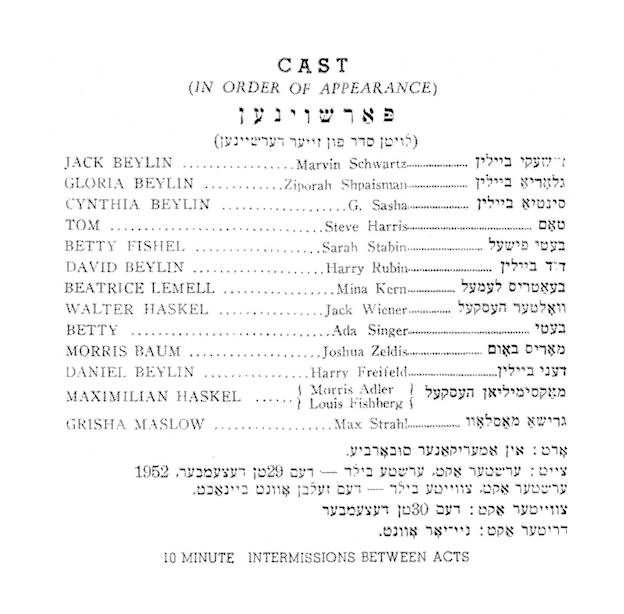
The Cast of Characters: |
|
The Synopsis: |
|
|
|
Place: American suburbia
Time: Act One - December 29, 1952
Act one: Scene Two -- Same day in evening
Act Two: December 30.
Act Three: New Year's Eve
Beylin, a
talented man of high integrity, is a writer and the
director of the Center. While Gloria, his wife, is
brooding over his rejected manuscript, Cynthia,
their daughter, maintains that lack of "sex" is the
reason. The disagreement turns into altercation
over Cynthia's infatuation with Alfred Stumpf, a
German. Cynthia leaves in a huff to meet him.
Gloria telephones her married son, Daniel, in
Philadelphia, asking him to try to influence Cynthia
to give up the German. Gloria wishes to shield her
husband from added aggravation, as he is in conflict
with the reactionary forces of the Center and is
also not well. The issue will be resolved and
Beylin's position in the Center determined at a
meeting the following evening. Mrs. Betty Fishel,
kindly, affluent woman whose son is interested in
Cynthia. Morris Baum, the outgoing president, a
simple, fair-minded and sensible man, support Beylin.
Jack, who worships his father and Gloria, naturally
stand by him. Tom, Jack's Gentile friend whom
Beylin permits, with other Gentile youngsters, to
use the sports facilities of the Center, admires
him. Beatrice Lemmel, president of the Ladies'
Auxiliary, Walter Haskel, an aspiring politician,
thwarted in his designs by Beylin, and Walter's
father, Maximilian, a wealthy plumber. The
two-pronged conflict in this act finds expression in
a violent encounter between him and Walter and a
dramatic curtain scene between him, Cynthia and
Gloria when Cynthia returns home late that night.
|
|
|
The next
day Jack and Tom practice trumpeting for
participating with the Junior League in serenading
Beylin the following night -- New Year's Eve.
Gloria vainly tries to persuade Cynthia to go to
Mrs. Fishel's New Year's Eve party. Daniel arrives.
He and Gloria try to persuade Cynthia to give up
Alfred but fail. Daniel leaves to see Alfred. Mrs.
Lemmel arrives and, warning Gloria that Beylin, if
adamant, would lose his job, tries to induce her to
urge him to alter his stand. Gloria refuses.
Cynthia strongly supports her father. Mrs. Lemmel
intimates that she knows of Cynthia's involvement
with the German. Mrs. Fishel, who comes to invite
Cynthia personally to the party, berates Mrs. Lemmel.
Daniel returns. He has established that Alfred
belonged to the Hitler Youth but feels differently
now. Daniel has also learned that Alfred and
Cynthia had fixed the wedding date. Gloria
reproaches Cynthia and slaps her. Beylin enters and
during the ensuing dramatic scene he learns that his
MSS had been returned. While he is still under the
impact of the blow, Morris Baum, Mrs. Lemmel and
Maximilian Haskel arrive as a delegation endeavoring
to persuade Beylin to admit his error. When he
accuses Mrs. Lemmel and Haskel of contaminating the
Center by trying to associate with "unclean"
antisemitic politicians, Mrs. Lemmel retorts; "Do
you manage to keep your own house from
contamination?" The delegation decides to turn the
case over to a Committee and leaves. Distressed,
Beylin accuses Cynthia of exposing him to obloquy in
the community.
New
Year's Eve. Beylin is waiting for the Committee's
decision. At his insistence, Gloria, accompanied by
her son Daniel, reluctantly leaves for her sister's
birthday and New Year's Eve party, but consoled by
the knowledge that Grisha Maslov, Beylin's Russian
student friend whom he had not seen for decades, was
coming with him to help her find a way, perhaps to
persuade Alfred to become a Jew. Beylin shows her
the futility of her request and the incompatibility
of Hun and Jew. But she insists that she could not
live without Alfred. Grisha arrives and the reunion
is moving. When Baum comes, Grisha leaves to buy a
bottle of champagne. Cynthia, torn between filial
love and her ungovernable passion, yields to the
latter and departs, leaving a letter. Baum informs
Beylin of the Committee's decision to discharge him,
unless he retracts. He refuses. Baum leaves,
Beylin finds Cynthia's letter. This final blow
brings on a stroke. Grisha returns with the
champagne and calls an ambulance. Having telephoned
and received no answer, Gloria and Daniel return.
Church bells and pandemonium proclaiming the New
Year are followed ironically by serenading.
|
|