|
A History of The Folksbiene
Uncle Moses
by Sholem Asch
1942-1943 season |
Riverside Drive
by Leon Kobrin
1942-1943 season |
|
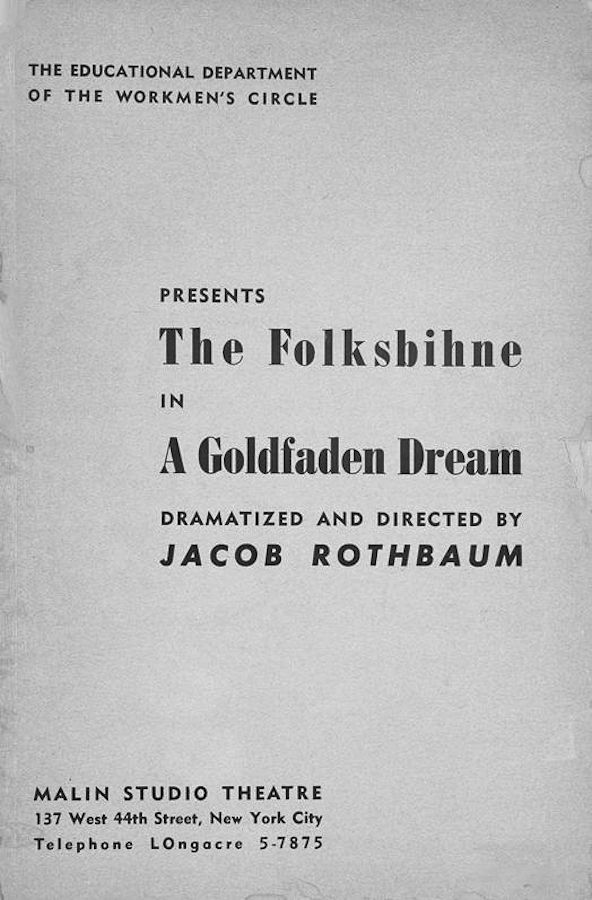
A Goldfaden Dream
dramatized by
Jacob Rotbaum
1942-1943 season |
Malin Studios
137 West 44th Street
New York, New York
|
|
|
|
After lengthy
deliberations it was decided that the Folksbiene needed
to embark on a new path, to associated itself with a
permanent director and perform more often. The company
was reorganized with Boris Levin as its chairman, and, at
the same time the manager of the ensemble of actors.
Jacob Rotbaum was hired as
the director, and on January 31, 1943, at the Malin
Studios, he staged his dramatization, Uncle
Moses, a drama in two acts and five scenes, from Sholem
Asch's novel. The play had thirteen performances.
On February 14, 1943, a
play in two acts, Leon
Kobrin's Riverside Drive, was staged in the Malin
Studio, condensed and directed by Jacob Rotbaum.
The play was performed thirteen times.
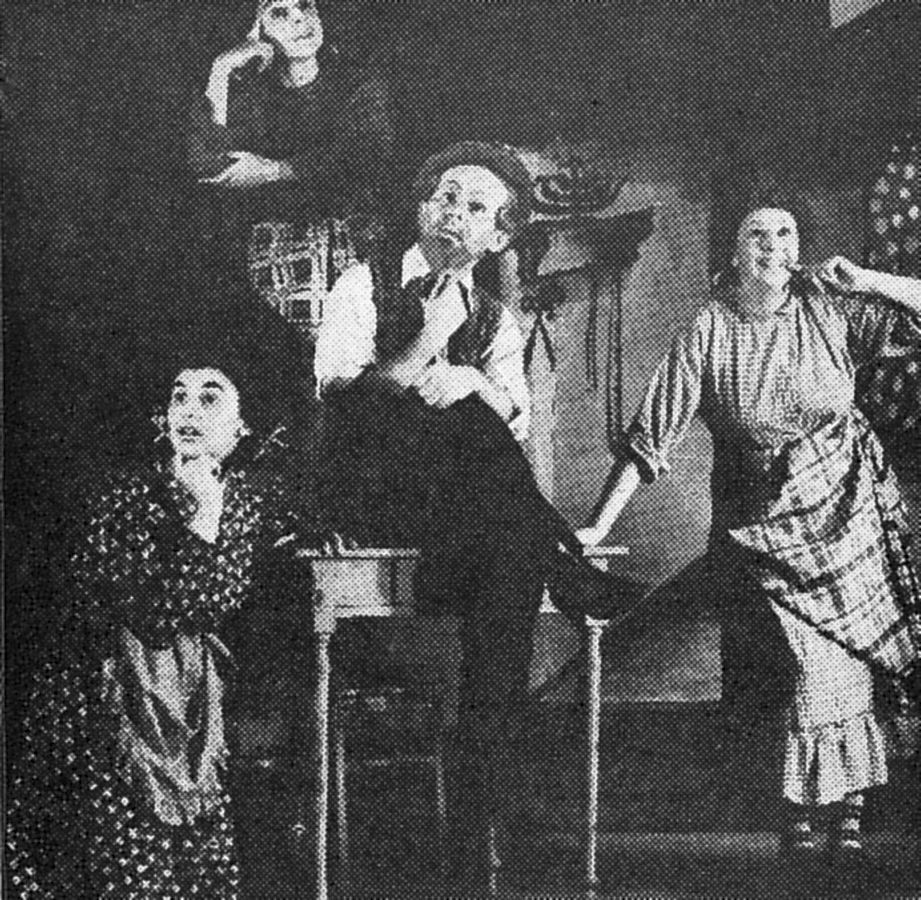
A special page in the history of
the Folksbiene is occupied by Rothbaum's staging of
A
Goldfaden kholem (A
Goldfaden Dream), a musical folk play in two acts and six
scenes, with texts by Goldfaden, Manger, Fenster
and Einbinder. This play was dramatized and staged by
Jacob Rotbaum, with music by Abraham Goldfaden and
Henoch Kon.
It opened in the National Theatre on May 5, 1943 and was
performed for the Arbeter Ring convention. Beginning on November
7 of the same year it also played at the Malin Studio, later in
Philadelphia, in the Parkway Theatre in Brooklyn, and later on
in the summer at the Arbeter Ring Circle camp, for a total of eighty-seven
performances. The play, the production itself, and the acting
evoked a great sensation in the Yiddish literary and
artistic circles and in the press. |
|
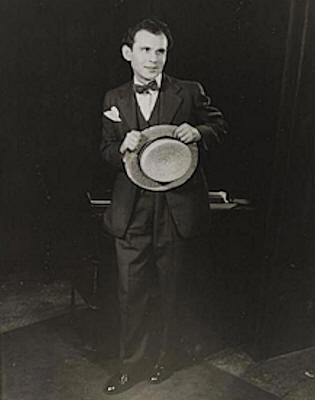
photo: Joshua Zeldis in "Uncle Moses," 1943. Courtesy of
the Museum of the City of New York.
|
|
|
|
|
|
|
|
|
 |
|
|
|
Cast of Characters: |
Synopsis: |
Oyzer
Mr. Hopke
Mirele
Nosson Hakoen
Kuny Lemel
Avrumche, Mirele's father
Bashe, Mirele's step-mother
Hotzmach I, a poor peddler
Zlatte, Hotzmach's daughter
Tzippe, Hotzmach's daughter
Soshe, Hotzmach's daughter
Hotzmach II
Hotzmach III
Linen Merchant
Provincial Customer
Bubba Yochna, a fortune-teller
Baile, Hotzmach's late wife
Marcus, Mirele's beloved
Policeman |
...
...
...
...
...
...
...
...
...
...
...
...
...
...
...
...
...
...
... |
Hyman Zaner
R. Aurnou, H. Rubin
Luba Bloom-Condell
Max Strahl, Max Neiditch
L. Mann, Benjamin Kramer, Harry Rubin
Louis Beck
Ana Beck, Ana Levine, Deborah Auerbach
Joshua Zeldis
Paula Eisner, Mildred Gurner
Renee Spector, Deborah Auerbach
B. Newman, A. Beck, R. Rosenzweig
Louis Beck
Boruch Feivelowitz
Morris Adler
Morris Dervin
Sarah Stabin
Eva Adler
Reuben Aurnou, Harry Rubin
J. Rosenblum, Mo. Pollack, Morris Adler |
Scene 1
Backstage of a modern Jewish operetta
theatre. An old prompter, Oyzer, lovingly dusts the costumes
belonging to the now-seldom played Goldfaden characters, and
reflects on the "good old times" of the Jewish comedy tradition.
Mr. Hopke, the director, urges his throwing out these "old rags"
to make room for the costumes of his coming play. The selection
which Hopke renders, so disgusts Oyzer, that the latter drowns
his sorrow in drink. Plaintively, he takes farewell of his old
friends; the old witch, Bubba Kochna, the simpleton Kuny Lemel,
the peddler Hotzmach, and the unhappy orphan, Mirele. He falls
asleep and dreams.
Scene 2
The garden of Mirele's home. In his dream,
Oyzer learns from Mirele that her beloved Marcus has disappeared
and that her stepmother and Nosson Hakoen, the High Priest, urge
her to marry Kuny Lemel. Oyzer is bewildered by this strange
phenomenon in which characters belonging to different Goldfaden
operettas are brought together. Seeing Kuny Lemel and Nosson
Hakoen before his eyes convinces him of the seriousness of
Mirele's plight. He decides to save her by taking her away to
the home of Hotzmach, the very poor peddler who always tries to
be of help.
|
|
Scene 3
Hotzmach's home. Hotzmach playfully
tries to make his three daughters forget their needs; a
dress for Tzippe, a pair of shoes for Zlatte, and a groom
for Soshe. Oyzer recalls their stage days, solicits
Hotzmach's aid for Mirele and gets a promise from him to
help her find Marcus.
Scene 4
The Market Place. Times are hard and
competition is very keen. Hotzmach, in his quest for
business, comes upon two other men identical with him in
name and appearance and also having three daughters with the
same needs. Together they attempt to buy linen from a
merchant on credit but fail. All they get is a sample card
each. Hotzmach I succeeds in selling his to a
provincial customer as 40 yards of cloth. Oyzer and Mirele
also come to the market in search of Marcus. They all turn
to Bubba Yochna, now a fortune-teller, for help. She is
elated, meeting her Goldfaden friends and very sorrowfully
relates that recently Mr. Hopke did not allow her. "The Old
Witch," the famous Goldfaden character, to enter his
theatre. Upon reading her cards, she learns of Marcus'
whereabouts, provides Hotzmach with enough money for a horse
and bids him speed in his search for Marcus.
Scene 5
In the Forest. Hotzmach rides in on his
horse, like Don Quixote. Exhausted by his search for Marcus,
he stretches out to rest and falls asleep. Before him appear
his late wife who commands him to provide for his daughters'
needs; and the embezzled customer who upbraids him and is
told that only dire poverty and desperation compel the
Hotzmachs to resort to such behavior. The customer, moved by
these pleas, gives him some money. But the dram gives him
some comfort for there his daughters' needs are fully
relized. The entrance of the other Hotzmachs awakens him.
Together all three go off to find Marcus.
Disguised as a Kuny Lemel, Marcus
enters and finds himself face to face with the original Kuny
Lemel. The latter, accompanied by the High Priest, is
looking for the vanished Mirele. The two Kuny Lemels create
a scene quarreling over Mirele and attract the attention of
everyone in the forest, including a tsarist policeman. He is
looking for an escaped political prisoner. Upon learning
that all assembled belong to the Jewish theatre, he
proclaims that performances in Yiddish in the tsarist realm
have been banned. A bribe saves the situation and the
policeman is soon off.
The original Kuny lemel begs Mirele to
go back with him but is chased away by everyone. Then Marcus
appears, removes his disguise and is joyfully received. To
Oyzer the happy ending conveys this meaning: that Goldfaden
does not desert his characters and that "good eventually
triumphs." Merriment and jollity ensue.
Scene 6
Backstage again. Oyzer, very much
encouraged by his dream, awakes and decides to leave Mr.
Hopke and his theatre. He is determined to help build a real
Jewish Folks Theatre based on the best literary and
theatrical traditions. |
|
