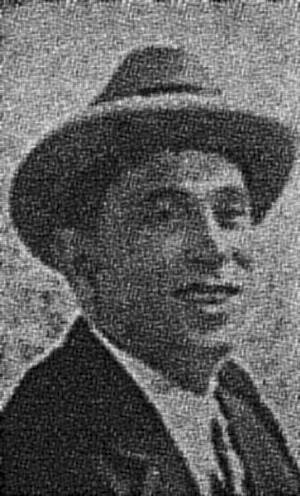
Later he acted in
operettas.
After appearing in
various troupes and touring all over Russia, he
was given a role in Warsaw, where he became very
popular as "The Litwack Comic." From
1912-1913 he performed in Lodz with Zandberg,
afterwards again in Warsaw, and during the First
World War he went to Russia, where in 1916 he
was drafted into the Russian army and sent to
Harbin. There he was able to make his life in
the army easier by often appearing in concerts
for the officers.
After he was
demobilized, during the October Revolution, Lebedeff
joined Avraham Fiszon's troupe, but because of bad
business dealings he often had to support himself by
singing in Russian and later in English for the
members of the American Red Cross.
Later he traveled to
Japan where he (and his wife Vera) organized
international concerts. In September 1920, he and
his wife came to America, and on October 12, 1920
he appeared in Boris Thomashefsky's National Theatre
in Wolf Shumsky's play, "Liovke Molodietz." His
success was so great, he became a star
overnight and remained one in the American Yiddish
Theatre.
On January 8, 1921, he
appeared in Boimvol's "Khatskele kol boynik." On
February 25, 1921, he appeared in Julius Adler's "The
Beautiful Bertha," and on April 7, 1921, in "Shloimke on
Broadway"
by Isidore Lash.
During the 1921-22
season Lebedeff was a star in Thomashefsky's
National Theatre. He performed, (alone or together
with Samuel Rosenstein) on October 28, 1921 in
Isidore Lash's "Yoshke khvat" (music by H. Wohl), on
December 25, 1921, in "Lively and Happy" (music
by H. Wohl) and on April 13 1922, in Kalmanowitz's "Arontshik
and Solomontshik" (music by H. Wohl).
During the 1922-23
season Lebedeff was again the star of Thomashefsky's
National Theatre, where he performed on September
23, 1922 in Boris Thomashefsky's "A Thousand
and One Nights" (director, composer, music by H. Wohl). On
November 3, 1923 he appeared in Kalmanowitz's "Dance,
Song and Wine" (director, B. Thomashefsky,
music by Joseph Cherniavski) and on January 26, [1924] in
Israel Rosenberg's "Yankele litvak" (directors L.
and S. Rosenstein).
During the 1923-26
seasons, Lebedeff was again in the National Theatre
(directors Louis Goldberg and M. Saks) and
he staged Moshe Schorr's " The Romanian
Wedding" (music by Peretz Sandler) on September 11,
1923; Kalmanowitz's "The Father's Son" (music
by Peretz
Sandler) on January 1924; on March 28, 1923
[sic! 1924]; N. Rakov's "Mendel in Japan" (music
by
Peretz Sandler); on October 3, 1924, Israel Rosenberg's
"Caucasian Love" (music by Peretz Sandler);
later Israel Rosenberg's "A Wedding
in Palestine"
(music by Peretz Sandler); on November 17; 1925, L. Freiman's "Models
of Love" (music by Peretz
Sandler), and on March 30, 1926, Isidore Lash's "Volodke in
Odessa" (music by Peretz Sandler).
During the 1926-1927
season Lebedeff and the National Theatre troupe
moved into the Brooklyn Liberty Theatre, which
opened with L. Freiman's "Siomke Becomes a
Bridegroom"
(music by Peretz Sandler) on September 22, 1926, and
later in the Public Theatre on April 15, 1927, he
staged Aaron Nager's " The Little
Millionaire"
(music: Sholom Secunda).
During the 1927-1929
season Lebedeff was involved in the National Theatre
(directors, Nathan Goldberg and Jacob Jacobs), where
on September 27, 1927, he appeared as "Fayvl Visotsky"
in William Siegel's "A Night in California" ( music
by A. Olshanetsky); on December 30, 1927, he and S.
Goldenburg had the leads in Siegel and Lateiner's "A
Paradise for Two" (music by A. Olshanetsky); on
April 5, 1928 he appeared in Isidore Lash's "Itsikl sholtik" (music
by A. Olshanetsky); on September 5,
1928, in William Siegel's "Golden Days" (music
by A.
Olshanetsky); on December 21, 1928, he played the
title role in Isidore Lash's "The Litwack
Yankee"
(music by A. Olshanetsky) ; and on March 29, 1929
Israel Rosenberg's "Hulye kabtsn" (music
by A.
Olshanetsky).
During the 1929-1930
season Lebedeff was involved in the Chicago Lawndale
Theatre and appeared in guest roles at the end of
the season in the New York National Theatre, on
April 9 staging Kalmanowitz's "Motke in Slobodke."
From 1930 to 1932
Lebedeff was involved in the New York National
Theatre (director, M. Saks) where
on September 23, 1930 he staged William Siegel's "A
Town Wedding" (music by H. Wohl); on
November 25, 1930, Isidore Lash's "Russian Love" (music
by H. Wohl);
on February 27, 1931, William Siegel's " A
Night in the Woods" (music by H. Wohl); on September 12, 1931,
William Siegel's "The Lucky Night" (music
by H.
Wohl); on December 3,1931, Avraham Blum's "The
Great Miracle" (music by H. Wohl); and on March 4, 1932,
William Siegel's "Rich Paupers" (music by H. Wohl).
During the 1932-1933
season Lebedeff was involved with Kessler's Second
Avenue Theatre (director, M. Saks) where he staged
Avraham Blum's "The Big Surprise" (music by H. Wohl)
on October 10, 1932.
At the end of that
season Lebedeff and the troupe, in which he played
guest roles, traveled to various cities in the
United States. On various occasions Lebedeff played
"Max" in Goldfaden's "The Two Kooney
Lemels," and
appeared in Goldfaden's "Di bobe yakhne"; played "Vorobeytshik"
in Gordin's "The Wild Man" and appeared in Chone
Gottesfeld's comedy "Tomorrow."
Lebedeff made many
records of his songs for the Brunswick Record
Company.
During his stay in
America, Lebedeff visited Europe a number of times,
but never appeared on the stage there.
M. E.
-
Ab. Cahan, " Another new
comedy in Thomashefsky's theatre," Forverts,
[Forward] N.Y., Oct. 14, 1920.
-
Lead Pencil [B. Botvinik]
"Who is the new Yiddish comedian, Lebedeff?"
Forverts, [Forward] N.Y., Oct. 15, 1920.
-
Jacob Kirschenbaum,
"How Lebedeff became popular in the Yiddish theatre"
Der amerikaner, [The American], N.Y., Dec.18,
1925.
-
Idisher Velt-Almanakh
,
[Jewish World Almanac] N.Y.,1926.
-
Dr. A. Mukdoni,
Theatre, N.Y., 1927, pp. 172-178.
-
A. Glantz, "Molly Picon and Aaron Lebedeff in two
new beautiful operettas," Tog [Day], N.Y.,
Sept. 30, 1927.
-
Aaron Lebedeff, "I and the audience,"
Tog
[Day], N.Y., Jan. 27, 1923.
-
A. Frumkin, "Aaron Lebedeff on starring in the
operetta," Morning Journal, N.Y., Feb. 3, 1928.
-
A conversation with
Aaron Lebedeff about his plans for the Yiddish
Lawndale Theatre," Forverts, [Forward],
Chicago, Oct. 11, 192?
-
B.Y. Goldstein, "Do
you know that ...," Fraye arbeter shtime (Freye
arbeiter stimme, Free Voice of Labor), N.Y., July
10, 193?