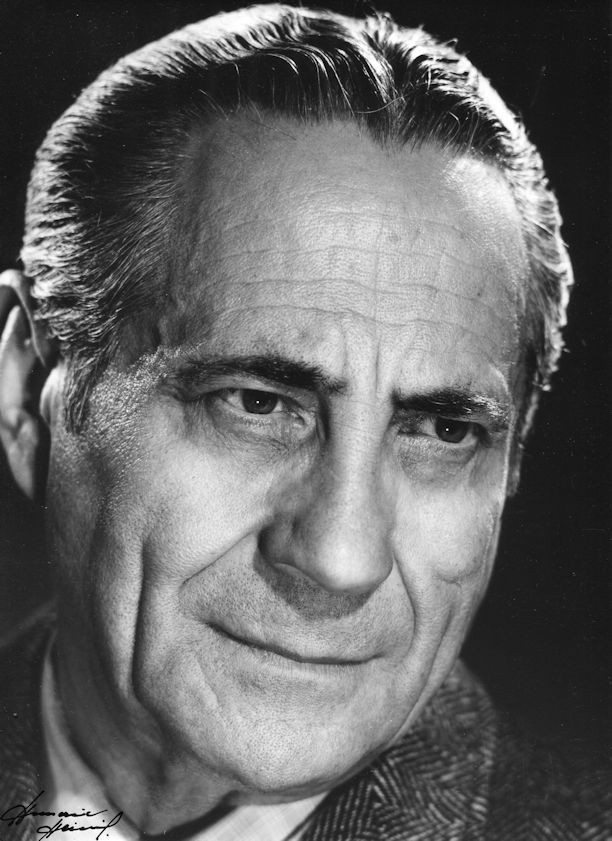
Photographers
unknown
Sitter
Joseph Buloff, January 20, 1899 - February 27, 1985
Date
unknown
Type
Portrait
Medium
Photograph
Credit Line
The Yiddish Theatrical Alliance
Testimony
“He doesn’t have to act,” wrote Maurice Schwartz, seeing him
perform for the first time. “His special twists and turns move
the audience so that they automatically break out in laughter.
Buloff was a born clown. For the rest of his life he could
merely play Joseph Buloff.”
And so he did, over the next sixty years, as
well as hundreds of characters on the Yiddish and
English-language stages, a longevity unmatched by few actors
-- and never less than a rave review. After the desertion of
Muni Weisenfreund (who would morph into Paul Muni) from the
prestigious Yiddish Art Theatre in 1925, Schwartz was
desperate for a replacement. Reports had come to him of a
remarkable actor currently the rage of Bucharest for his
imaginative adaptation of and performance in ‘The Singer of
His Sorrows.’ Though young and relatively inexperienced,
Joseph Buloff was part of the famous Vilna Troupe. He’d been
in the premiere of Ansky’s masterpiece ‘The Dybbuk.’ For a
decade, the Troupe had built an enviable reputation,
performing quality ensemble theatre with a repertoire of the
finest Yiddish and mainstream plays. Maurice Schwartz’s own
Art Theatre had in great measure been inspired by the
Vilna’s ideals and practices.
Born in Vilna on December 6, 1899, Buloff
grew up in the chaotic atmosphere of war and revolution
convulsing Eastern Europe at the time. His own home life was
equally unsettling because of a father who’d made a fortune
in America and lost it in The Pale. But determined early on
to become an actor, emotionally unsuited for anything else,
he edged into the shabby Elysium Theatre in Warsaw and told
Leib Kadison, the Vilna Troupe’s founder, of his intention.
“Very good,” was Kadison’s bemused response. “And where do
you live?”
“I don’t live yet,” came the gritty reply.
He was soon to however, blossoming with the
Vilna, becoming its finest player and winning Kadison’s
lovely talented daughter Luba to the bargain. By 1923, the
Troupe had fractured, one branch going off to play Berlin
and other Western capitals. Joseph and Luba took their group
to Bucharest and quickly won accolades from the average
Yiddish theatre-goer to King Carol, the reigning monarch.
Then the fabulous Maurice Schwartz beckoned, and after
months of negotiations, the Buloffs emigrated to America.
Growing fascism in Europe helped influence the decision."
Source of Testimony
Martin Boris -- "Joseph Buloff: An Appreciation"