|
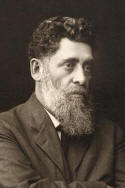 |
JACOB GORDIN,
... the
playwright, whose plays were seldom sung and whose
plays had no music at all, was himself a great lover
of music. In the old country he was a music critic,
and here in America, every Sunday, he used to
arrange private concerts at his home every Sunday.
He was a frequent visitor to the Metropolitan Opera
House, mainly he loved the Wagnerian operas. |
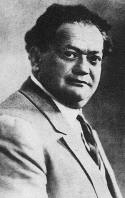 |
RUDOLPH
SCHILDKRAUT,
... who had
excelled in his natural acting, began his theatrical
career as a clown in a circus. |
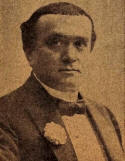 |
MORRIS
MORRISON,
... the
Jewish-German actor used to say that such actors as
Jacob P. Adler and David Kessler would have been
famous on every world stage, but an actor as Sigmund
Mogulesco had just no world stage. |
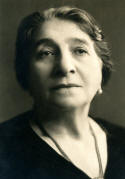 |
BINA
ABRAMOWITZ,
... who they
call "The Mother of the Yiddish Stage," very rarely
publishes her opinion about actors and actresses.
When asked, she replies that "with a mother, all
children are equal." |
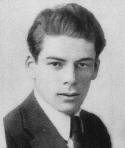 |
MUNI
WEISENFREUND,
... at the age
of fourteen, he played the role of a long-bearded
father. |
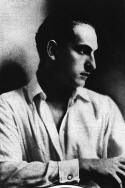 |
JOSEPH
SCHILDKRAUT,
... the son of
the famous Rudolph, learned to play the violin
easily, and he considered making it his career. |
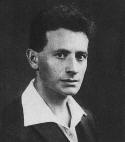 |
JACOB
MESTEL,
... who came to
Yiddish theatre when it was an officer in the
Austrian Army, is very much a character He is a very
strong man. An Yiddish actor once kindly said to
him, "Come on, you are a lemeshke [weak
person]." Mestel joked in German: "What am I? A weak
person!? Do you know that I am an Austrian officer?
Here is my business card. Tomorrow we will have a
duel." |
 |
IZIDOR
CASHER,
... who plays
evil, upset, angry people on stage, rarely gets
angry and upset in his private life. |
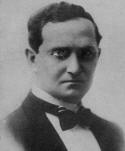 |
JOSEPH
SCHOENGOLD,
... who has
devoted much time and energy to forming his lovely
manor voice, loves to sing in private, and also in
the dressing room. In the theatre, however, he
doesn't like to sing on the stage. To him, singing
on the stage is a hardship. |
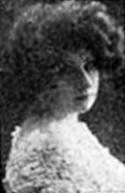 |
SARA ADLER,
... used to cry
on stage with real tears. Mainly she was the most
natural Yiddish actress. |
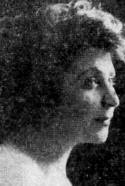 |
BESSIE
THOMASHEFSKY,
... when she
used to play a tenor role, she used to copy Boris
Thomashefsky in both walking and speaking. |
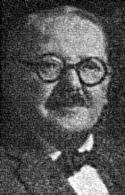 |
JOSEPH
EDELSTEIN,
.. the pioneer
of Yiddish theatre managers, has most of his money
in Yiddish theatre! He made it with operettas.
He also had great dramatic successes, but he used to
rarely enter into his theatre when they played a
drama. His explanation is: "I hate trouble, I hate
trouble." |
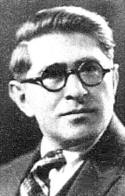 |
WILLY
PASTERNAK,
... the manager
of the Second Avenue Theatre, does not know the word
"no." |
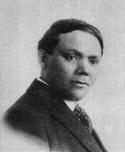 |
GERSHON
RUBIN,
... the
talented born Litvak had to play on the Yiddish
stage for the first time with David Kessler in a
German play, "Virginius," the role of a count and
spoke with a Berlin High German ... |
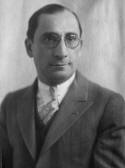 |
CHARLIE
COHAN,
... who is the
secretary of the Actors' Union, is so accustomed to
speaking with actors about dues, that he often
forgets when and where. He had such a scene in a
play with an actor who plays the role of his
partner. the "partner" needs to say: "Thank God, we
both are not coming at all." Charlie also needs to
say: "Thanks God." Charlie forgot and said, "Who
told you that? You're not coming, but your union
dues are coming up in a couple of lovely weeks." |
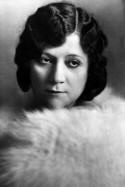 |
ZINA
GOLDSTEIN,
... has a
tendency toward the German operetta and hopes
sometime to found a Yiddish operetta theatre, which
will perform German operettas in Yiddish. |
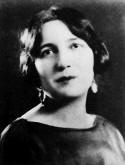 |
ROSE
GREENFIELD,
... when she
tours in the province, she writes a letter to her
husband every day, and if one day it is not possible
to write, she writes two letters at a time the next
day. |
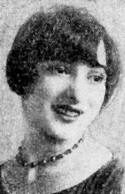 |
GERTIE
BULMAN,
... acts in
every play that will be played through the week. But
even if she finds that she has a night free, she
comes to the theatre to see what her colleagues, the
actresses, do. |
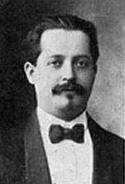 |
HERMAN WOHL,
... who excels
with his heartfelt Jewish melodies, loves to hear
compliments, that he writes good jazz music. |
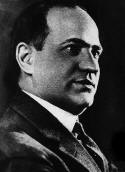 |
JACOB
WEXLER,
... expresses
his love and friendship with a strong punch in the
shoulder, with a true Jewish curse. |
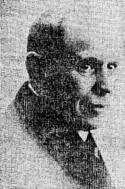 |
ABRAHAM
FISHKIND,
... loves to
tell jokes for the actors; and they love to hear the
jokes. The whole theatre family once agreed that
they should not laugh from his jokes, however good
that they may not be. The only one who could not
restrain himself and broke the agreement, was Berl
Bernstein, who himself was a volcano of laughter.
|
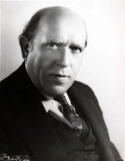 |
JOSEPH
RUMSHINSKY,
... has a habit
when he conducts his orchestra, turning around his
head and looking at the public. He hears remarks
many times and kibitzes with the audience behind
him. One of them says: "Are you checking to
see if the house is packed? I wish I could see so
many people in my grocery store all year long, how
many you have today."
A second says:
"There, there, there (indicating with his hand) sits
a beautiful, young girl."
A third says:
"You can look at my Jews as much as you want. I have
more fun looking at your actresses." |
|
