|
|
|||
 |
Joseph
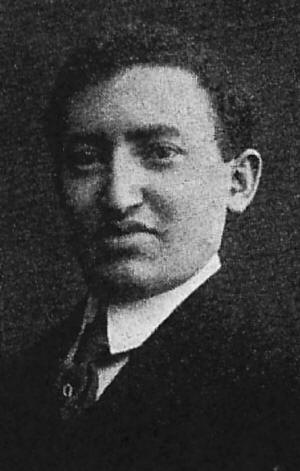
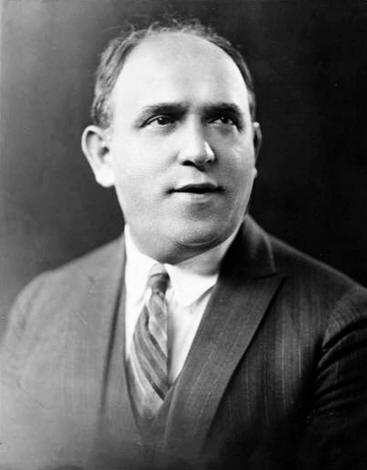
Rumshinsky Writes About the Former and Deceased Couplet Writer and Actor, Louis Gilrod* His character and his role in the Yiddish theatre Written especially for the "Forverts" by Joseph Rumshinsky
March 21, 1930
|
|
|
|
|||
|
|
Joseph
Rumshinsky Writes About the Former and Deceased Couplet Writer and Actor, Louis Gilrod* His character and his role in the Yiddish theatre Written especially for the "Forverts" by Joseph Rumshinsky
March 21, 1930
|
|
|
Even in his family life, the fifty-fifty motif reflected him as both a man and a father. Fifty-fifty is the sad leitmotif of Gilrod's life -- saddened by this alone, who, having no confidence in himself, made every undertaking only half-successful. When he went to play a role, he soon remarked: Who am I? Am I such a comedian as "this" or "that"? --- calling [out the names of] some of the great comedians of his generation. When he went to manage, he initially agreed with himself that he could not be unsuccessful, because he was not such a manager as this or that. In short, he was one of those rare types who, instead of waiting for someone else to lend him a way, did it himself. In only one area did he succeed, because there he could save his sick soul. This was the lyrics. In his lyrics and in his songs he felt more free and comfortable than in his other callings, and he entertained around the theatre and at the theatre. Irving Berlin, the Jewish-American songwriter, once explained that if he had attended [both] high school and studied music, he would never have been so successful. He would not have been so popular because his language would have contained a beautiful, literary word, and in the music -- a beautiful and fine tone that would have removed the popularity of the songs among the masses. "There is no news under the sun" -- there is no news under the sun. At home we had the critics, or the authors of songs, about the day-to-day happenings of a city or town, for example, a song about the butcher's daughter, who escaped with a lightning bolt, or about an evening of Passover bloodshed, or about the man's daughter who drowned because of an unrequited love. Here are all the badkhans (comedians) and authors of these kinds of songs in our home, here the folk-authors were very far from being able to write poetry and music. These were simply folk people, whose music and words were accessible to the masses. These domestic badkhans and domestic song composers in America are the successful songwriters. I mean to say that the type of our domestic badkhans and domestic song writers is the same type as the American "songwriters"; here they call them with the ringing name: "Tin Pan Alley Musicians," half of whom are musicians who write for the street and for the masses. The difference between our domestic badkhans and song authors, and these local "song-writers," is this, that the first is poor as a beggar all his years, and the latter becomes a rich man, even a millionaire, with only one successful song. Louie Gilrod was virtually an Americanized young man. He had to watch as his colleagues, who wrote the same stuff that he, the same kind of songs, become stone-rich, and he wrote year-in-year-out, and he was always a bad beggar. This made his life very sad and defiled his thoughts. It is possible that what Irving Berlin said about education and the success of a songwriter is correct. If yes, it explains Gilrod failure, because among the American "song-writers," both English and Yiddish, with the exception of a few, Gilrod exceedrf them, both in taste and in ... , with a head above them. Gilrod not only fabricated words, he also sought to incorporate a soul, a kindness into them. I know this from my own experience. When working with him, I was often impatient because people would make him ("hurry up"), push him: -- -- So, Gilrod! -- I used to write. -- A little faster, it's clear enough, a little more, a little less. Let's get ready! And he used to ask: -- Let's clarify. After a few words. Maybe let it be beautiful. Perhaps one can fail to this or that degree. Grind. Perhaps the idea can be brought out poetically already with it. Gilrod himself used to search for the soul in a song all the time. He didn't feel at home when he came to write religious or national songs, such as "Toyre'le," "Israel'kel,"A Mother's Heart," but he felt much freer when he needed to write sad and love songs, such as "Blimelekh tsvey," "A Mother's Heart," "Golden Bride," or a humorous song mixed with sarcasm, such as, "In Around a Hundred Years," or his last song in the "Jolly Orphan," or "Ya vas lyublyu" (I Love You.) In this song he points out the difference between the American screaming "I Love You," to the Russian sentimental "Ya vas lyublyu": "Ya vas lyublyu" -- Das iz das zelbe vas "Ay lov yu," Dakh iz es nit Azoy hartsig gut.
Vi der "ya vas lyublyu." For example, in the coffee house, where he very much loved to philosophize, he spoke these words: -- Who am I, and what am I? -- I would have told you my opinion, -- he used to go on to say, a little hoarse and coughing, -- but what's my opinion? This is when an opinion would be expressed by this or that actor (called a big star), or when my opinion is expressed by this or that musician. Or a manager, he would be heard, but me? Who am I, and what am I? And he used to finish: -- When Kasten sings my song, "Fifty-Fifty": "I am never entirely one hundred percent." That's what you all mean, pointing with his long, dry hands. -- But I ... I feel very different. What do I mean? Friends ... wake up! But one thing is for sure, for all of you, for the entire theatre profession, even for my family, I have been and will remain a "fifty-fifty." Yes, Gilrod was right, not only that his life was a "fifty-fifty," but even his death: He was somehow taken away, [and we were] not even told exactly about his funeral, which was a shocking and sad one. Fifty percent of his colleagues did not even accompany him. Yes, his life was a "fifty-fifty." And who knows whether his soul was an entire hundred percent ... |
Copyright © Museum of the Yiddish Theatre. All rights reserved. Image Use Policy
Copyright © Museum of Family History. All rights reserved. Image Use Policy