 |
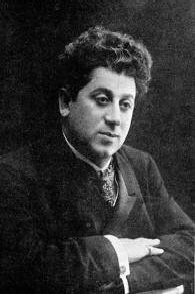
THOMASHEFSKY SPEAKS FROM THE HEART
It speaks about the Yiddish
theatre of yesterday and today -- |
 |
|
Dear Mr. Editor of the "Forward" -- You must allow me (that is, I do not force you, God forbid), but I have a certain right in me, which entitles me in your worthy newspaper, to be a little discouraged. I mean, God forbid, I should not insult anyone, I should not touch anyone on the floor, I should not honor anyone. As Hamlet says - "Let the cretaceous scratch" ... I have the freedom and the right -- and indeed rightly so -- to throw myself among all the opinions, interests and aspirations that have been going on in our small, restricted, despairing, crippled, depraved, poor Yiddish theatre world, poor thing ... Someone else in my place might have begun to shout, make a commotion, and shout from Second Avenue over every corner of Greater New York: another might have grabbed every passing Jew by the throat and shouted: My Jews, dearer, brighter customers of mine. You, who know us and provide us with fish and horseradish, with kugel and tsimes, automobiles and houses, with unions and wages, -- you Jews, who carry your hard-earned dollars to the box office with your workday earnings; you Jews, who are being squeezed and compressed into the line at our ticket offices in the theatre. The special officer, the gendarme, the acolyte, the governor-general of the lobby, throws you and pushes you, and many times he kills himself for you for money, for your pleasure, for your search for Jewish art and artists -- you are so childish-naive and let yourself be kneaded and made of you whatever one wants ... I would even cry out with vehtog, with bitterness, with gall, and spit out and shake everything that is united and not united at the Yiddish theatre. Another would at once pull down the cloak that represents and covers so much, injustices, inaccuracies, theatrical effective screaming and exaggerated advertisements, and would point out whomever was throwing sand in the eyes, fool yourself and fool others with insidious tricks, with attachments that are neither here nor there, neither to the heart, nor to the soul. Not for a Jew, not for a Gentile, not for Europe. Wherever a Yiddish piece of paper is printed as a newspaper, it appears several times a week in stupid, silly, weekly interviews with artists and actresses. Quite simply, very ordinary bshrudm'nikes -- artists who have never created anything here or at home, Jewish artists, whom mother nature has chosen and approved of, instead of being a cantor in a synagogue, an overseer in a dress, or something smooth like a craftsman or a blacksmith. Or a she with a beautiful face, with a dry figure and very limited talent, who still needs to go onto the Yiddish stage for many, many years and learn to reread their own role ... I'm not talking about characterization, from working out, inventing, polishing, immersing oneself in all quotations, penetrating sorrow, joy, everydayness, feelings, phases, transitions, facial expressions and so on and so forth, which is as deep as eternity, as infinite as the universe -- Here those who shout, scream, throw sand in the eyes and fool our newspapers, our readers, our customers, fool themselves in public, that they are misguided poor ... their place is not where they are. To take wages, play pinochle, and think of lovely dresses and summer in the country, and more and more ... Poor literary artists! I think my heart that you have fallen into such a great calamity, and so just come out with me, not God forbid on the battlefield, (we have had enough wars already), but simply with true words, with clear, with pure, not stifled and not imagined bees come out, tell me, or leave it. Do you know through newspapers what made you during your time at the Yiddish theatre? What characters are you left with? Who did you bring with you from Europe? What made you richer from our poor repertoire? Why are you crying with false tears? How do you advertise yourself as an artist? What do you mean by your fate in public? You yourself, in your hearts, know that you are deceiving yourself and deceiving others as well. Do you want to hear what I have to answer you, here -- we have no Jewish literary artists, no literary theatre and no literary repertoire. If a lovely semi-literary play ever pops out, it's nothing more than a miracle. It simply means that the thing is so strong that even our weakness could not kill it. To have a literary, a true literary theatre, it should stand on the same level as the Comédie-Française Theatre in Paris, or as Reinhardt's German Theatre in Berlin, as the Burgtheater in Vienna, and the Russian Art Theatre in Moscow. This was the birth of new Jewish artists and writers. And all that we did 20 or 25 years ago, and all that falls on the walls today is nothing more than self-deception. We are still in our own sphere, that is, when we meddle in our own lives and we seek to imitate, imitate, or copy things, characters, scenes, with which we are well acquainted. Then we are halfway home and we can satisfy ourselves and others. But if we start climbing on strange roads, in strange lands, in foreign lives, then we see that we are falling onto the same walls. And the audience, the big, broad audience, the big, big masses feel it, understand it and cry to us and pray to us: Children, you are still very young. First of all, were you born there and came into the world? Who wants to follow the great? You will fall, great people, older people, experienced people will recognize your youth. Your naivety, your push towards old age with means, to which you have no power. I don't want to quarrel with you, God forbid. On the contrary, I have in all my years lived with you in peace, and I want to continue to meet you with a joy, or God forbid vice versa, with friendly looks, with gentle eyes, with your hearts, fire and hatred. My dear Yiddish actors! Have any of you ever thought about what a mighty leap we have made in the short time of our existence? There is still the first generation that raised the first theater curtain, showed their first mask to the Jewish public -- the old Zuckerman, the first Yiddish actor lives and will live a long time; he still plays with me in the theatre. There still lives our Jacob Adler, the first Yiddish actor, who forty years back in Russia played "Acosta," "Zhidovka (Jewess)," "Mother Love." Thirty years ago I played "Hamlet," "Romeo," "Othello," "Huguenots," "Don Carlos," "Ferzunkene gloke," "Richard III," "Macbeth." Besides my large repertoire, I have I also stumbled on the same walls until I realized that neither we Jewish artists, have such a right and right to do so, nor do we have a public that cares about us. Yiddish theatre, we need Yiddish -- from Yiddish artists playing, and from Yiddish writers writing. And we need Yiddish directors, which should be born first. I remembered a little scene, which I have to write down, because it fits in very well here. When Abraham Goldfaden for the first time came to New York thirty or so years ago, I had the honor of going with him to the Yiddish theatre for the first time. This was at the former Roumanian Opera House in the Bowery. I had then my company in Philadelphia, playing in "The Two Sergeants," a French drama. The two God-blessed artists Kessler and Feinman played two French soldiers, speaking in German, singing in German, on the stage Jewish gentiles were seen. Nor were they once soldiers, not Kessler, not Feinman -- they behaved like soldiers, -- neither the clothes were fitting. None of the sets fit, none of the artists knew what they were playing, none of the small audience that sat in the theatre understood why a spadek was played on the stage. Every time Goldfaden had a heavy sigh. After the first act I asked: "Mister Goldfaden, why are you sighing like this, do you not like the theatre? Didn't you like the play?" "No," he said to me -- "My friend, this is not my Yiddish theatre. I have given them a Yiddish child, and they have destroyed it." And here lies a great, great truth -- We Yiddish actors are Goldfaden's children, and no matter how much we wrestle and twist on all sides and use natural and unnatural means, we will always remain Goldfaden's educated children, a little older, a little nurtured, a little polished -- but still theatrical children. Even today, with all our progress in literature, there are still Jews who take great pleasure in the former songs of Goldfaden; even today a Jew is resurrected when he hears a song from "Shulamis," "Bar Kochba," "Doctor Almasada" and "Ni-be-ni-me" ... Have you thought about why this is so? ... What magic lies in the hidden? Why does this attract the Jew here to Yiddish song, to Yiddish music? After all, we have lost so many years working together, lost so much money trying, so many powers lost in vain to make the old and bring in a new tone, a new spirit, a new life. And what have we accomplished? What effect did the world-famous imperial-royal actor Morris Morrison, whom I have brought to the Yiddish stage, have on the great Jewish masses? Once in several weeks he gave a production and barely had enough means for a poor life, and he died in foreign shrouds. Morris Morrison had played for kings and princes. Gifts from king and count had Morris Morrison on its chest. All of Europe adored him. Morris Morrison was with us as a young man, and what did Morrison have when he died? -- The greatness, the recognition that he acquired among the nations of the world, he also lost in our field, on our stage. Who knows how to appreciate our Rudolf Schildkraut, the great actor of our time? I brought him onto the Yiddish stage. I told him to be a Jew among Jews. I persuaded him to leave the German theatre that had brought him here to guest-star. I created a path for the great Schildkraut, and for our theatre attendees, that Schildkraut should come with his large world repertoire and perform for our audience his great artistic roles, with which he excited the entirety of Germany, Austria, Romania and Russia -- "King Lear," "Shylock," and other great things from his repertoire. What was the result in the end? Schildkraut went away, back to Germany, and the great Schildkraut again was the king of art. I first mentioned a few weeks earlier Schildkraut's famous role he played in Berlin that year -- "The Wanderer," with sets that cost ten-thousand dollars; a ballet that the great Russian Royal Ballet Master had done -- a sacred production, an artistic production, a production of honor for us Jews. And what was it in the end? Ask me. I am the master of things. The art production cost me twenty-thousand dollars. Twenty-thousand dollars was simply added. I will tell you a secret, which you might not have known. Men and women left the theatre and cursed, but cursed with deadly curses. Children, free our effort! We need to play what we can and give the people who need it, under a beautiful form with a rich ensemble, a more natural performance. But do not climb on the walls. Do not descend to heaven. Only play beautiful, clean, neat Yiddish theatre.
|
Copyright © Museum of the Yiddish Theatre. All rights reserved.
