|
Uriel Mazik's
Picture Gallery of Our Yiddish Actors |
||
|
1. -- Leon Blank |
||
|
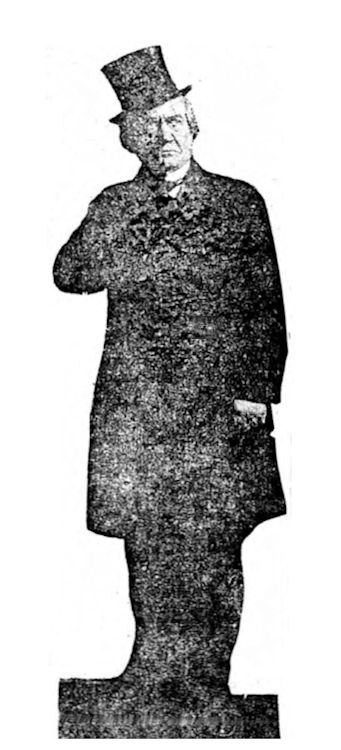
One looks at Blank when he's on stage. One must smile involuntarily. He is a blessed Jew. Here is the one with the soft, heartfelt voice that reminds of a close, close friend. In whatever role he may appear, we truly love him. Is Blank a talent? Do we really mean a talent? To answer this, we need to make clear what it means to be an actor and a talent. Often sitting among our people and watching what one is made of, what one laughs at, it is difficult to give a precise explanation as to who is a true talent and who is not, or who has no talent at all. When do we call a writer a talent? When he can, with his writing, influence us in such a way that we should believe, see and feel him according to the colors in which he painted the picture; And the more he makes us believe and feel, the more gifted he is. This does not mean that every word that we read is true; it may not be true, it may be a fantasy, a dream, but as soon as he makes us believe him, he is recognized as a gifted human being. Is it also the same with the theatre? Can we apply the same measures to our artists? It turns to how one looks at the thing. Here we see people turning around, jumping like comedians, speaking a language that no living creature speaks and yet, weeping and laughing, people applauding and murmuring with murder at their actor when they see something bad. Then it seems that we have no actors, no audience and no theatre. but a stupid, awkward vaudeville house that dislikes Purim plays. It becomes heartless then, and it wants to regret our poverty, our savagery and stupidity. But here, amidst all this hoo-hah, a living man appears, with a dejected soul, he speaks well, he feels deeply, he touches us without the noblest feelings. With his aristocratic power, he opens for us on the throne to the human soul. Such is the case with Leon Blank. * * * Often, looking at our actors, you think that you really do not like them, that they speak beautifully, behave elegantly, bring out certain very strongly, with temperament. But there is something more to them, that if they do not leave a deep impression on us, they are soon forgotten. As one leaves from the theatre, there is no spiritual connection between the actors and the audience, and they remain alien in the distance. One can, for example, take and insert in place of the Jewish spectators others, Gentiles, one only has to call the actors speak in Gentile and the effect will be the same. We hate such actors, and God is not a bad person at all. They are a kind of an international type. Wherever they may be, they will be able to carry out their roles, even if they only know the language. |
|
|
But here we have a second kind of actor, who when we look at them, dances in our hearts for joy, and somehow we remember old things, long-gone images, our fathers and grandfathers stand before our eyes, the words, the mimic is close to us, familiar, we've seen it before, we laugh and cry, a stroke of our soul has been touched. Let a Gentile come to my place, he will not understand at all, he will squint his eyes and will perhaps feel disgust. But I understand it, I love it just as much as the pious prayer and pious mimicry of our fathers is dear to me. Such actors are Yiddish actors. They paint for us the deep Jewish life, with its joys and sorrows, with its faults and virtues, and to this kind belongs Leon Blank. When he plays the shoemaker in the "Greenhorn Millionaire," or the Jewish poet in "Israel's Hope," characters that are far different from each other as east is from west, he understands, however, in both he must bring out the typical Jew that they are, with their virtues and vices. One must admire how deeply he immerses himself in the character where he presents himself as the Jewish shoemaker, who places our lives on the lowest level with which one is ashamed in the family. However, he is a Jew, with all the Jewish sides, and he does not fall for himself, he speaks, as is in the grave times of misery and oppression, yet he is a cheerful beggar, with the specific Jewish optimism and irony to evil and malice. He always dreams about his family, even though he allows himself to throw a glance at a passing girl, and he will even have an abundance too, but nonsense, not evil. Behold, one is nevertheless a living person, and as Peretz sings there: "For one choice, a Jew also commits an offense." But on the other hand, one has God in his heart, and his wife and children are always in mind; And if Mr. Blank still catches up with the masses and rarely does he goes here and there with a two-word proverb, this is not because his talent demands it, but alas, it is out of simple habit. * * * Alas and alack, that it is how our Yiddish writers and poets live, abandoned, torn apart and abducted. They are dragged about in God's world, but they have a great mission for us, our judges; The terrible troubles, one's own exile, the uncertainty of tomorrow, makes life inexhaustible, and moreover, in this new world, where the heart and the soul are torn in two, we must have whomever it may be. For we carry a light; and who can do this better than our judges and writers? After all, they are the best, the most advanced that we have. How easy it was to create a character of the poet in "Israel's Hope," a little insignificant man who writes rhymes, oykh mid a mensh! With an unfortunate tenor, with a false touch, out of this Jewish dreamer and singer would emerge a bit of a fool, a madman. But thanks to Leon Blank, who understood his task, such a sympathetic figure emerged, not looking at the fact that the poet occupies the second or third place, it is that he became the most beloved person, and he attracted all the attention to himself and that was just thanks to Leon Blank's true artistic understanding of his role.
But, after all, Blank is in the role
of popular people, and here he is in his atmosphere. His calmness,
his hearty laughter, the way he utters one word, are very
reminiscent of a very popular type among us Jews. This is the type
of Tevye the Dairyman, who is the embodiment of the deepest, Jewish
features. He is a popular person, a simple, country Jew, the Tevye,
with the innate, Jewish cheerfulness. Leon Blank would have been a
rare artist to bring out popular people of Tevye's kind. * * * As of late we also have seen Blank in a shund piece. A foolish operetta, full of dirty allusions, it and was a joy to see how Mr. Blank turned around there, like a clay golem and was unable to do so. There are many more suitable "artists" who can shout, make noise, and turn all-vaudeville; and if there was one who did not have a sense of responsibility, Blank was required to whistle when he closed his palms and went into a little dance. We heard a young couple shout in alarm: -- Look, look, Blank is getting tired too, how does it fit for him? In truth, it did not appeal to talent, the true artist, because Mr. Leon Blank is a true, Yiddish actor, and not a vaudevillian or Purimshpiler. |
||
Copyright © Museum of the Yiddish Theatre. All rights reserved.