|
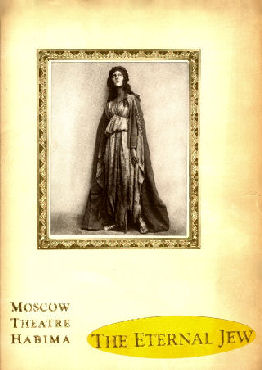
"THE
ETERNAL JEW, a historic drama in a prologue and
two acts, by David Pinski, with music by
Alexander Krein. Settings by N. E. Yakulow;
staged by W. L. Mtschedelow; presented in Hebrew
by the Habima Players. At the Mansfield
Theatre."
From the NY Times review,
"Habima Players Act 'The Eternal Jew'"
December 21, 1926
"...The Pinski play is concerned with the
destruction of the Temple and the fall of
Jerusalem and relies for its tragic effect upon
the intense realization of the significance of
that event...The performance was...a very
interesting exhibition of the Habima's methods
and a demonstration of their courage. It may be
suggested that what they were attempting was
impossible because they undertook to combine
melodrama with a theme too lofty and
sublimate.The opening, after the music which
suggested the fall of Jerusalem and the cries
and the weeping of the inhabitants as the
Romans slew and burned, was a colorful bazaar
scene in the little town in Palestine where the
entire action occurs. Merchants cried their
wares and then came women bargaining and plying
the most ancient of their trades. There was a
fat member of that most ancient trade who danced
in scant garments which hardly conveyed the East
somehow. But the rest of the Oriental color was
highly effective. So was the heavily accented
and mask-like make up of (sic) the men, with the
sharp hooked beaks on the faces and deep shadows
around the eyes. It is a curious fact that the
women were not made up to match.
...Naum L. Zemach
as the "Stranger," who is the central figure of
the play, was the chief sufferer from the
curious situation which the combination of play
and method forced upon him. The most effective
individual player was Anna Rovina as the young
woman, mother of the child, who is marked by
prophecy as the Messiah. She stood out as an
intensely tragic human being in the midst of a
too obviously stylized group. Especially was she
effective in her chants of grief over the child,
so unhappily born on the day of the destruction
of the Temple...
...The scene of
the action is a town within a few days' journey
from the Holy City. Into Birath Arba, along with
rumors of the calamity which has befallen
Jerusalem, comes a man with a strange story of a
child that he shall find there--a child born in
the hour when he temple fell and destined to be
the saviour of his people.
The man seeks the
child in the guise of a peddler of swaddling
clothes. But the elders of the town refuse to
believe him--or, indeed, to believe that
Jerusalem has really fallen--and he narrowly
escapes being stoned to death by the populace.
For nobody has heard of such a child. Then comes
a strange young woman lamenting that her child
is accursed because he was born in that evil
hour for his people. The young woman has come
all the way from Jerusalem, fleeing from the
destruction and the massacre. Messengers also
have arrived with tales of other fugitives.
So the peddler of
swaddling clothes is proved no bearer of false
tidings, and the elders are persuaded. But at
that moment comes a servant crying out that the
child has disappeared--vanished in a whirlwind.
And the peddler walks out from the clamor of the
astonished crowd to continue his search for the
Messiah..." |