|
Here are two reviews of this
production of "Golden Land." The first is from "Plays to See," from
July 15, 2017. It was written by Paul Meltzer:
Is it unprofessional for a
reviewer to stand at the ovation, all wet eyes and grinning?
This Jewish immigration musical
journey gives you much more than you bargained for. Yes, it takes us
through leaving the old world, navigating Ellis Island, being a
disoriented greenhorn on the bustling Lower East side, toiling,
moving on up to the "fancy-shmancy" Bronx, enduring calamities. But,
wow, they execute the kishkes out of this show!
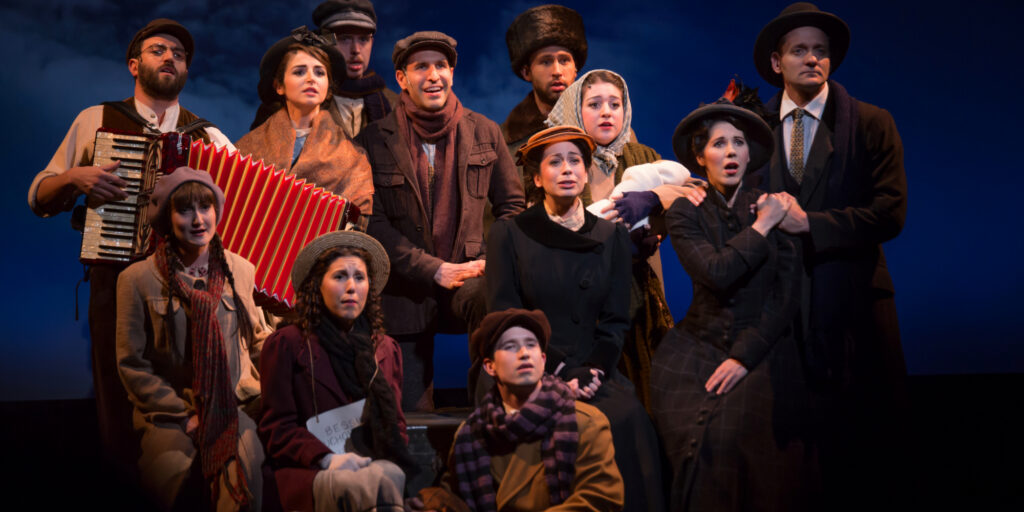
You get a punchy, soulful eight-piece
orchestra and a cast of fourteen including chorus. And, oy mammeleh,
what can these people not do? Vaudeville routines, dramatic moments,
period pop singing, arias, pitch perfect old radio commercial
harmonies, dancing in full-blown choreography -- and all in Yiddish
yet! All -- not just the funny words. (Don't worry -- there are
supertitles in English, and interestingly in Russian. We heard a
fair bit of Russian spoken in the audience.) You get a taste of
Yiddish theatre, including a spookly witch dance from Macbeth. And
you'll hear a "Roumania, Roumania" that will give you shpilkes.
Yiddish was the language of Eastern
European Jews from the Middle Ages until the middle of the last
century when it mostly gave way to the Holocaust, to the embrace of
Modern Hebrew in Israel, and to assimilation in the U.S. As a lived,
spoken language, it is now primarily the province of Chasidim and
the Ultra-Orthodox. But it preserves as if in amber the whole world
of Eastern European Jewish life. For those like me who remember
Yiddish-speaking grandparents now long gone, it's jarring and so
touching to see them as young people, not knowing their futures,
hopeful, believing in America, finding and losing their way in the
tumult of urban life. The Yiddish carries their upswinging,
unresolved, ironic intonations and helps us feel how completely, as
immigrants, they were living in two worlds.
The show indirectly serves a couple of
causes in addition to generally telling the story of Eastern
European Jewish immigration to the U.S. There is a strong
labor-rights bent, such as in the song "Fifty-Fifty," about how the
wealthy should sweat and share equally with workers. The labor
movement was very deeply woven into the experience of these people
that went directly from Ellis Island to the sweatshops of the
garment industry. And there is a general plea for the need to accept
immigrants fleeing desperate situations, as they did. There is a
little religiosity, very little, mostly a cultural reverence as in "Lekho
Dodi," where we experience how universal Shabbos (Sabbath)
observance was among those long laboring, thankful for the true
blessing of rest. But the deepest reverence in this show is for the
words of Emma Lazarus on the Statue of Liberty in the song "Give Me
Your Tired, Your Poor."
Sure, it's a pageant. It's very
earnest. People here seem nicer than in real life. These immigrants
are not hardened or embittered, or neurotic or difficult in any way.
They love each other, and they break into song regularly. But as the
host demonstrates for us in her WEVD Yiddish Radio cooking show, a
little shmaltz makes things transportingly delicious.
______
Here is a review from the New
York Times, dated August 3, 2017:
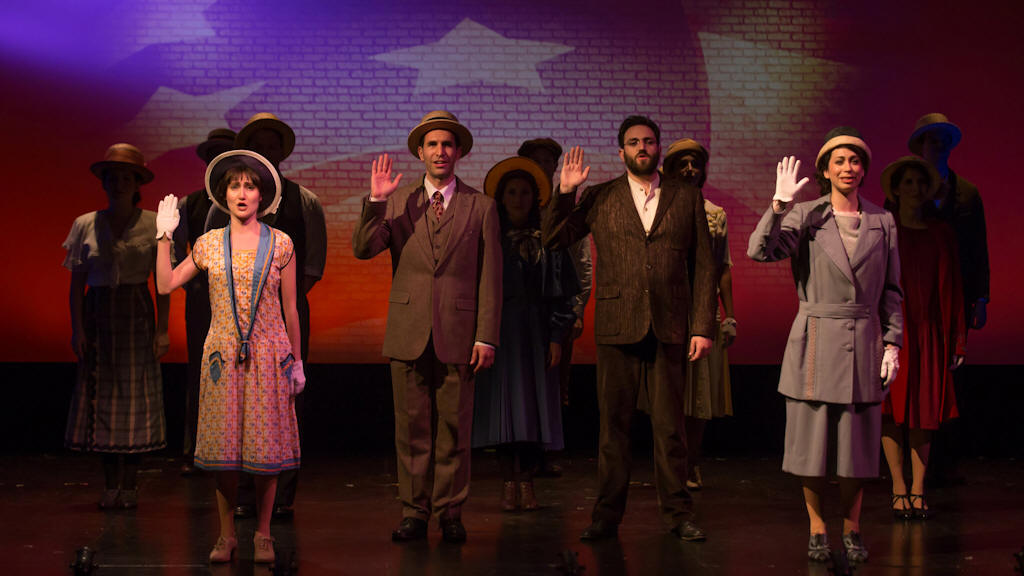
Emma Lazarus's words inscribed
on the base of the Statue of Liberty -- "Give me your tired, your
poor, Your huddled masses yearning to breathe free," set to song by
Irving Berlin -- announce the ending of "Amerike -- The Golden
Land," playing at the Museum of Jewish Heritage within earshot of
Lady Liberty herself.
A reimagining of Zalmen Mlotek and
Moishe Rosenfeld's 1984 musical, here presented entirely in Yiddish
with Russian and English supertitles by the National Yiddish Theater
Folksbiene, "Amerike" tells the story of Jewish people's emigration
from Europe to America in 1897 and their adjustment through the
1940s.
Something between a review and a
textbook chronology of Jewish history of New York, "Amerike,"
directed by Bryna Wasserman, toggles between friendly gibes at
American culture and somber accounts of past hardships. Revues
typically invite more playfulness than "Amerike" allows, though it
finds its heart in moments of self-aware mugging, whether it's an
unhelpful Jewish radio weatherman shrugging off the forecast as
"neither here nor there," or witches toiling, troubling and
kvetching in an early Yiddish theater's take on "Macbeth."
However, with a sprint through more
than 40 musical numbers, the musical's attempts to encapsulate such
horrors as the Triangle factory fire in three-minute songs feel
rushed and didactic, one melody bleeding into another.
The 12-member company's harmonies
stand out in "Bread and Roses," a poem-turned-anthem for women's
labor rights, as does the lively choreography in "Mir Arbetn." Among
the individual performers, Stephanie Lynne Mason is in full-bodied
voice in "A Brivele der Mamen" and "Vi nemt Men Parnuse?" Daniel
Kahn has a trumpeting vocal style, while David Perlman's grinning
enthusiasm is infectious.
Framed by scaffolding and moving set
pieces resembling brick walls, the staging recalls the landscape of
old New York -- until the focus shifts to projections on the
backdrop, where flat images and graphics detract rather than add.
Ending with Lazarus's words (this week
a subject of social media debate) may be too neat for a show that
addresses -- both sincerely and ironically -- the complications of
the American dream. But "Amerike" mostly aims to educate
museum-goers and share in nostalgia for Jewish-American culture of
yore -- and at that it succeeds.
Above all, in this xenophobic moment
the show dares to celebrate a cultural history in which America
might help shape a people, and, most important, in which a people
might help shape America.
________
 |