|
A History of The Folksbiene
God, Man and Devil
by Jacob Gordin
1975-1976 Season
Central Synagogue Auditorium
123 East 55th Street
New York, NY
|
Cast of Characters: |
|
|
|
A review appeared in the New
York Times on November 11, 1975:
Stage: 'God, Man, Devil'
Yiddish Play Opens at Central Synagogue
By Thomas Lask
Unlike other plays in Yiddish, Jacob
Gordin's "Gott, Mensch un Tyvel" ("God, Man and the Devil") does not
require the ambiance of the Eastern European Pale or the shtetl for
its effect or its effectiveness. It is not a nostalgic romp through
the past, nor a play whose point derives from the breaking up of
ancient folkways or the widening gap between generations.
Borrowing both from the Book of Job
and the Faust legend, Gordin contrived a play built on the struggle
between man's better nature and his evil spirit. The working out of
that struggle represented by Hershele Dubrovner, a poor scribe
suddenly become rich, and the devil in the form of Uriel Mazik, a
lottery ticket-seller and promoter, is the heart of the play. |
|
Satan (later Uriel Mazik)
Pipernoter
Leyzer Badkhn
Pesenyu
Freydenyu
Tsipenyu
Khatskl Drakhme
Dobe
Motl
Hershele Dubrovner
|
...
...
...
...
...
...
...
...
...
...
|
Leon Liebgold
Jacob Gostynsky
Joshua Zeldis
Mina Kern
Marilyn Gold
Ruth Selman
Morris Adler
Zypora Spaisman
Moishe Rosenfeld
David Ellin
|
|
|
|
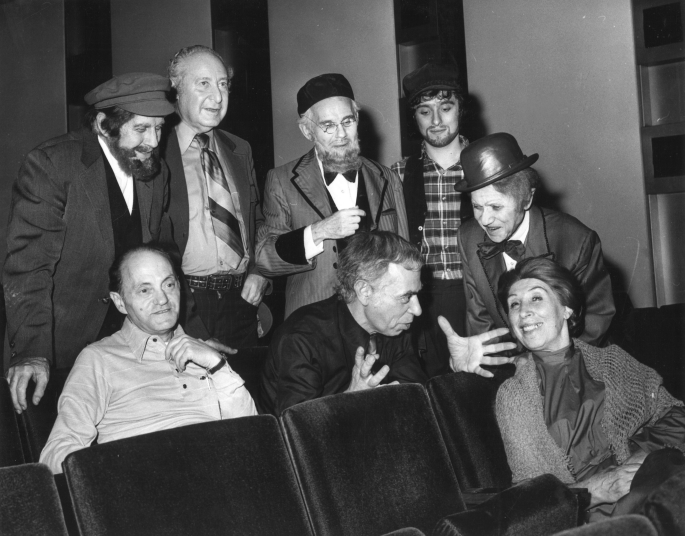
Left to right, seated: Ben Schechter, Israel
Beker (director) and Zypora Spaisman.
Left to right, standing: Unk., Sheftel Zak, Joshua Zeldis, Moishe
Rosenfeld and Jacob Gostinsky.
courtesy of Moishe Rosenfeld. |
|
|
|
In the prologue, God and Satan debate
the worthiness of man, and Satan receives permission to test mankind
by testing Hershele. Sure enough, money does corrupt the man. He
does away with his holy work, divorces his wife, thrusts away his
friends until just before the brink he draws back and performs the
one act he hopes will redeem his past.
Obviously it is a play that no matter
how subtle, its implications are rather broad in incident and
characterization, and it was played so at the Folksbiene production,
now being given every weekend in the auditorium of the Central
Synagogue. Nevertheless, it is a play whose closing pages have an
impressive and moving power, well realized in this production.
Under Israel Beker's resourceful
direction, the play moves rapidly and he has met the challenge of
the play head on by neither skirting nor emphasizing its pathos or
melodrama.
As the tempted man, David Ellin gives
a fine-grained performance, full of good will and saintliness at the
beginning, broken and confused at the end. As Satan, Leon Liebgold,
owner of a superb speaking voice, was satirical and seductive.
Though somewhat operatic in pose and posture, he was an abrasive
foil to his adversary. Joshua Zeldis brought increasing dignity to
his part as Hershele's disillusioned father. Marilyn Gold was all
innocence and ardor as the young wife, and Zypora Spaisman was her
usual salty self as the wife of Hershele's friend. The smaller roles
were nicely integrated into the production.
"Gott, Mensch un Tyvel" is an
old-fashioned play in that its theme could not be easily treated
today -- even in Yiddish -- in the terms in which Gordin conceived
it. But it is a genuine Yiddish classic that in the Folksbiene
production retains its life and character. |
|

