|
A History of The Folksbiene
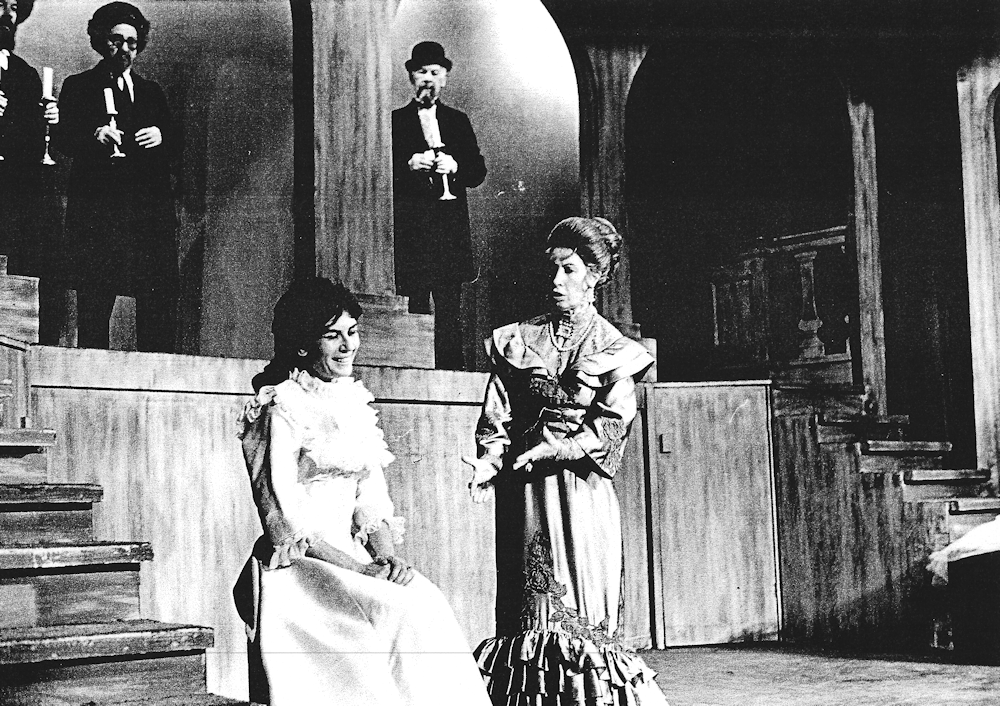
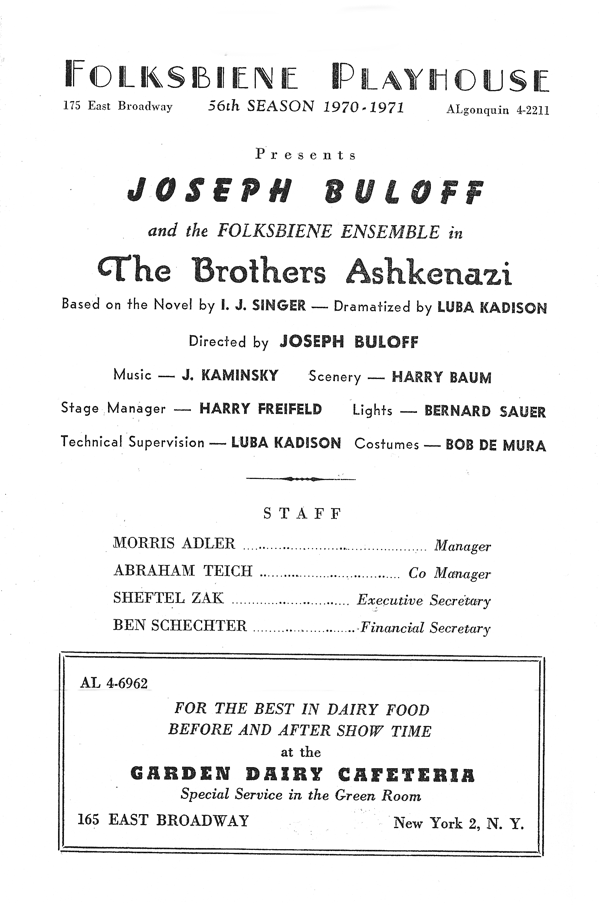
The Brothers Ashkenazi
By I.J. Singer
1970-1971 Season
Folksbiene Playhouse
175 East Broadway
New York, NY
 |
|
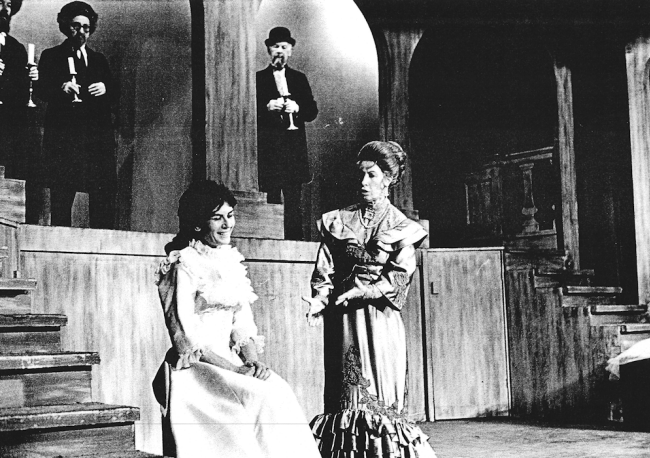
Leda Kurtz and Zypora Spaisman.
|

From right: Mina Kern, Zypora Spaisman,
Joseph Buloff, Ruth Ellin and Elya Arnou.
Photographs courtesy of YIVO.
|
| |
|

Menashe
Oppenheim, Zypora Spaisman, Mina Bern, Sara Stabin, Joshua
Zeldis, and Joseph Buloff
Courtesy of the Museum of the City of New York
|
| |
|
A review from the New York
Times, November 17, 1970:
'Brothers Ashkenazi' is Staged
by Folksbiene
by Thomas Lask
In one passionate scene in Luba
Kadison's Yiddish dramatization of I.J. Singer's panoramic,
multilayered family chronicle, "The Brothers Ashkenazi," the
elder twin, Simkhe Meyer, who likes to be known as Max,
complains that his wife, who hates him, and nowhere more
fiercely than in the marriage bed, has not kept her side of the
contract.
"Your mother brought your body,
but she has kept your soul," he says to a hushed and
appreciative audience. There aren't many theatres in the United
States where such a line can be safely uttered, where an
audience will accept it as a just statement of the case. Scenes
like these are sprinkled all through the performance of the play
now being given weekends by the Folksbiene group.
Those who would like a change from
Pintersque silences and Beckett-like repetitions, from the
eyebrow lifting, monosyllabic muscle twitching kind of acting
that is so common these days will find the Folksbiene
performances a rich and juicy alternative. Emotions are
encountered head on, scenes are milked to the last tear drop or
ounce of pathos, and the acting, like the language, is full of
hyperbole.
To the charge that there is little
subtlety or finesse, everyone connected with the enterprise
might easily say that they are dealing with the very stuff of
life in all its coursing vitality.
In the center stands Max, a man on
the make, one who rises from his expected role as a brilliant
student of Scripture to become the boss of the manufacturing
city of Lodz. Sly, cunning, tricky, keeping his own counsel, and
light years ahead of others in understanding the industrial
process, he takes on all comers: his father, who renounces him
because of his failing piety, his in-laws, whom he has neatly
relieved of their business, his wife, his children, who feel
alienated, his competitors (naturally) and his employees, who
are just beginning to realize what they must do to obtain
justice for themselves. He beats them all handily until history
moves in to show him who is really running things.
Miss Kadison's version is long and
talky, and its episodic structure does away with climaxes. But
she has created a meaty and wide-ranging role for Max, which
Joseph Buloff plays to the hilt, revealing every facet of the
man. It's a pleasure to see such expertness at work.
No other part measures up to that
one, but I liked Zypora Spaisman as the tough-minded mother of
the bride and Menashe Oppenheim as the simplistic,
self-righteous father-in-law. Leda Kurtz brings something
intense and unsatisfied to her part of Max's wife.
Miss Kadison's Yiddish lines are
flavorsome and supple, and she has even managed to get in a
reference to Singer's central idea: that whether Jews are
wealthy or poor, radicals or pillars of society, apostates or
believers, there is no salvation for them in the Diaspora. |
| |
| |
|
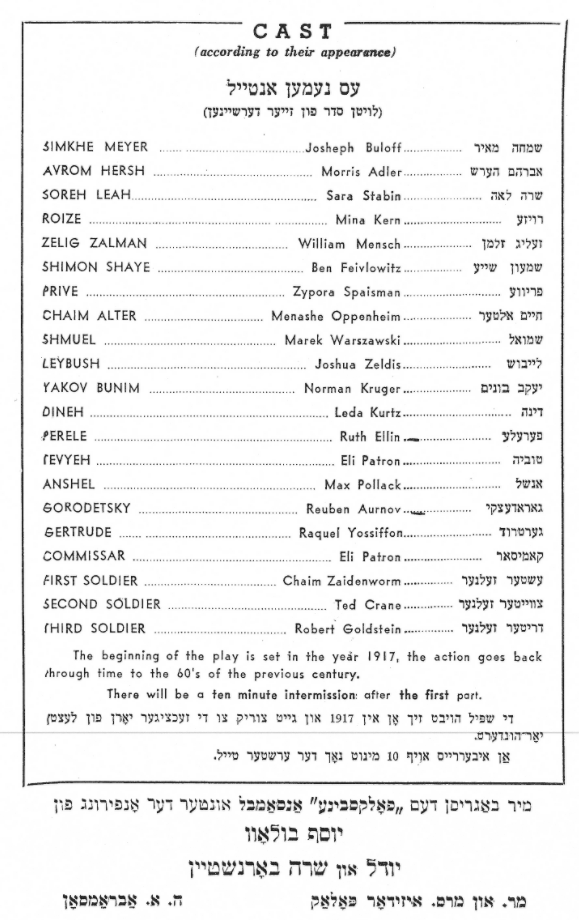
The Cast of Characters: |
|
The Synopsis: |
 |
|
The
elderly Max Ashkenazi (Simkhe Meyer), the so-called
Czar of industry in the city of Lodz is arrested at
the outset of the Russian revolution in 1917.
He is weak
and weary. During the interrogations, he is forced
to undergo several times daily, the same things are
repeated over and over again. He finally breaks
down and retreats to the world of visions of his
past.
He sees
the day of his birth as the beginning of the chain
of events leading to his present imprisonment. He
was born the twin brother of Yakov-Bunim who was
always "handsome and young" while he was always
"ugly and old." The perennial struggle with his
twin is what he now pictures in his mind.
As a
child, Dinele (now his wife) wanted to play only
with his handsome brother. Yet, his own quickness
of mind and later erudition in the holy books so
impressed Dinele's parents that they forced her into
a marriage with Simkhe Meyer. He then begins the
battle to win the affections of his wife which goes
through the traditional stages of naiveté,
worldly
determination and settles in a bitter struggle.
Simkhe
Meyer becomes a partner in his in-law's textile
factory. Upon discovering that his brother is
employed by the firm, he drives it into bankruptcy
and proceeds to take it over. Yet, while his
in-laws maintained their sympathetic attitude
towards him, his wife remains cold, even after the
birth of their first child, Gertrude. This only
increases his suspicions that Dinele is still in
love with his brother. As he reflects now, he feels
his actions to assure him that "his wife is his wife
and his child is his child," were justified. In the
meantime, Yakov-Bunim, because of his great charm,
marries a certain Perele with a dowry of one million
rubles which enables him to assume a leading
position in the textile industry of Lodz. Simkhe
Meyer extends the war with his brother into this
field. The revolutionary weavers, naive and
oppressed, fall under his influence. The father of
the twins, Avrom-Hersh Ashkenazi, who is
also involved in textiles, sides with Yakov-Bunim
and severs all ties to his other son. Simkhe Meyer,
in total isolation, decides to achieve control over
the whole textile industry and thus eliminate all
those whom he sees as standing between himself and
Dinele. As he reflects now on his later actions, he
cannot help but marvel at his own talent for
language and the daringness of his plans.
|
|
The
unsophisticated weavers are slowly agitated by their
co-worker Tevye and confront Simkhe Meyer with a
list of demands.
Yakov-Bunim
leads a carefree life of luxury and pleasure. The
one complication is the affair he is carrying on
with his niece Gertrude. To avoid an open scandal,
he decides to divorce his sickly wife Perele in
order to marry Gertrude. He asks Dinele to win his
brother's consent. Simkhe Meyer's anger knows no
bounds as he tries to break the love Gertrude feels
for his brother. He even drops hints to the effect
that Yakov-Bunim is her true father.
In the
meantime, World War l ends with the Revolution in
Russia. Simkhe Meyer is thrown into prison as an
undesirable. Yet his brother, his mortal foe, the
motivating force behind all his schemes, is the one
who in the end frees him by the "appropriate" use of
great sums of money.
He finds
Simkhe Meyer in a collapsed state. The daily
interrogations are so much a part of his physical
conditioning that he can no longer free himself of
them. As the carefree Yakov-Bunim is taking his
brother home, he is stopped at the Polish border and
loses his life.
This could
have been the liberation of Simkhe Meyer but he can
no longer escape from the prisons of his own mind.
In these
prisons, he sits and mourns his conquered twin and
there he sees his last vision--reality is more
complex than he, Simkhe Meyer, had believed and he
is only a small part of that reality. He makes his
last impassioned appeal to the tribunal in his mind
in his unconquerable conviction that he has the
strength to begin again.
|
|